Sexual Wellness Treatment for Men and Women in Bend and Seattle
Clinics In Bend & Seattle. Also serving Oregon & Washington via telehealth
Feel like yourself again.
Sexual wellness treatment addresses the hormonal, vascular, and neurological reasons that desire, arousal, and comfort change over time. At Flow Wellness, treatment options include testosterone or estrogen optimization, PT-141 for desire, compounded arousal creams for women, low dose vaginal estrogen for dryness and painful sex, and prescription tadalafil or sildenafil for erectile function and blood flow. Everything begins with a full symptom history and a plan built around your body rather than a template. We see patients in Bend, Oregon and Seattle, Washington, with telehealth follow up across Oregon & Washington.
Sexual concerns are among the most common things patients bring to a hormone clinic and among the least often addressed honestly. Many people spend years being told their labs look fine, that this is simply aging, or that nothing can be done. That is not accurate. Most sexual concerns have identifiable contributors, and most of those contributors respond to treatment when the evaluation is thorough enough to find them.



2025 & 2026 Finalist for Best Men’s Health Services
2025 & 2026 Finalist for Best Women’s Health Services
Two Ways to Start: Treat the Symptoms or Find the Cause
You do not have to commit to a full workup to get help. Some patients want relief from a specific problem and want it soon. Others want to understand why their body changed. Flow Wellness supports both, and you can move from one to the other whenever you are ready.

Starting With Medication for Symptom Relief
If your concern is well defined and your health history is straightforward, we can often begin treatment at the first visit. A man with erectile difficulty and no cardiac contraindications can start tadalafil or sildenafil. A woman with vaginal dryness and painful sex can start low dose vaginal estrogen. A woman whose desire has faded but whose arousal and comfort are intact may be a candidate for PT-141, and a woman whose desire is present but whose physical response lags may start a compounded arousal cream.
This path is deliberately practical. It gives you something that works while you decide whether you want to look deeper, and it produces useful clinical information on its own, because how you respond to a targeted therapy tells us something about what is driving the problem. Even this shorter path includes a real medical evaluation. We review your cardiovascular history, current medications, and contraindications before prescribing anything, which is the part that online prescription services tend to skip.
Symptom directed medication manages the problem rather than correcting what created it, and some patients find the response incomplete for exactly that reason. A man whose testosterone is at the bottom of the range often gets a partial result from a PDE5 inhibitor alone. When that happens, the deeper evaluation is the logical next step rather than a sign that treatment failed.
Going Deeper With a Full Hormonal Evaluation
If you want the root cause, the first visit is comprehensive. We take a full sexual history, which means asking about desire, arousal, lubrication or erectile function, orgasm, pain, and satisfaction as separate items, because they have different causes and different treatments. We review medications, sleep, alcohol, stress, relationship context, and medical history. Nothing about this conversation is rushed or judgmental.
Lab work follows. For women that typically includes estradiol, total and free testosterone, sex hormone binding globulin, DHEA-S, progesterone when cycling, thyroid panel, prolactin, and metabolic markers. For men it includes total and free testosterone, sex hormone binding globulin, estradiol, LH, FSH, prolactin, thyroid, complete blood count, PSA where appropriate, and a lipid and metabolic panel. Labs interpret symptoms rather than replacing them.
Treatment is then layered rather than stacked all at once. We generally correct the hormonal foundation first, give it time to work, and add targeted therapies for whatever remains. This sequencing matters because a compounded arousal cream will underperform in tissue that is estrogen deprived, and an erectile medication will underperform in a man whose testosterone is at the bottom of the range.
Follow up occurs at six to eight weeks with repeat labs and symptom review, then at intervals appropriate to your therapy. Sexual function is one of the more sensitive markers of whether a hormone plan is dialed in correctly, which makes it a useful signal for the rest of your care.
Choosing Between Prescription Supplements and Hormonal Evaluation
Neither path is the wrong answer, and the choice is usually about what you want and how much is going on.
– Symptom directed medication suits a clear, isolated concern in someone who is otherwise well
– Hormonal evaluation suits fatigue, mood changes, sleep disruption, or weight change alongside the sexual symptom
– Hormonal evaluation is the better starting point if a previous prescription underperformed
– Anyone can begin with medication and add the workup later, and many patients do exactly that
– Anyone already receiving hormone therapy should have the sexual concern evaluated within that plan rather than separately

Sexual Wellness Treatment for Women
Female sexual concerns are rarely single issue problems. A woman with painful sex often develops low desire in response to anticipated pain, and a woman with low desire often reports that arousal and lubrication faded first. Treating the full picture produces better outcomes than treating the complaint that arrived first.
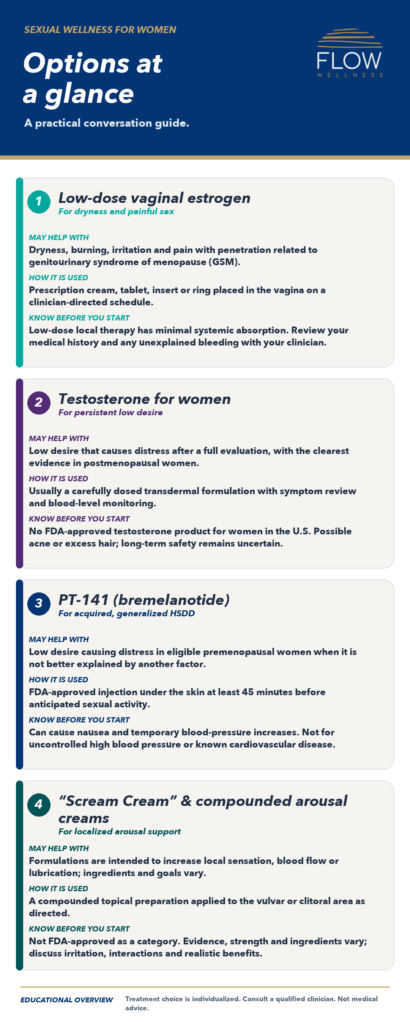
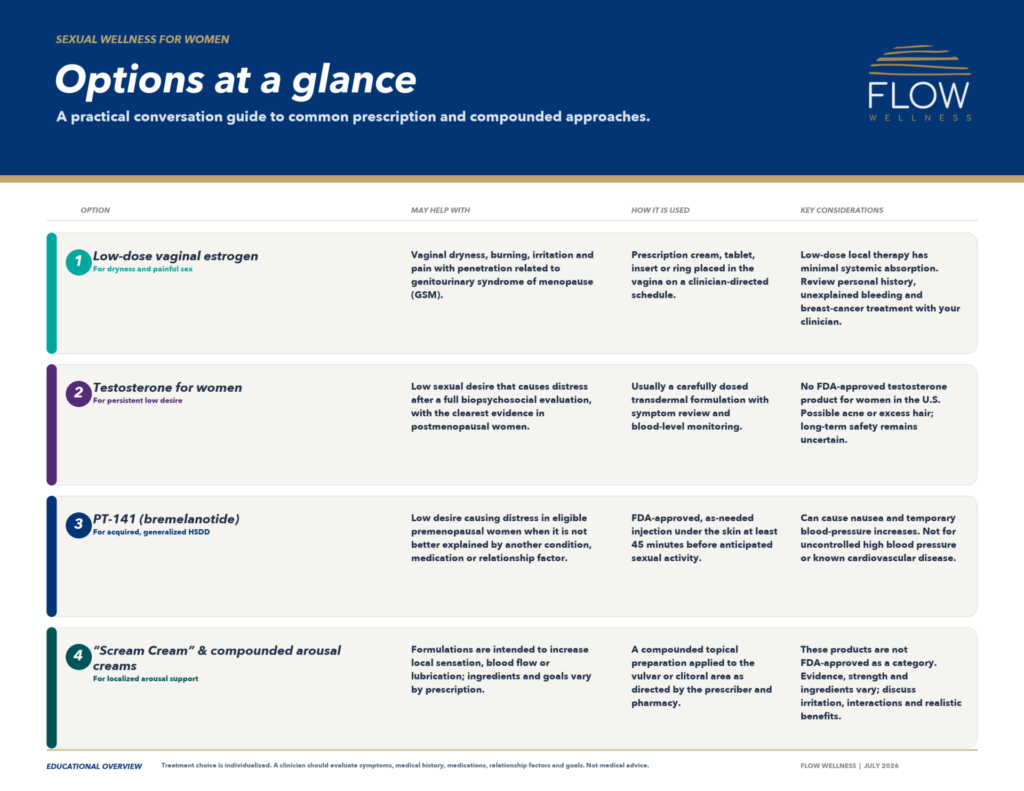
Low Dose Vaginal Estrogen for Dryness and Painful Sex
Genitourinary syndrome of menopause is the current term for the changes that estrogen loss produces in vaginal, vulvar, and urinary tissue. It affects a large majority of postmenopausal women and is substantially underdiagnosed and undertreated.¹ Unlike hot flashes, it does not improve on its own with time. It progresses.
Low dose vaginal estrogen delivers estradiol directly to the tissue that needs it, with minimal systemic absorption. It restores tissue thickness, blood flow, natural lubrication, and healthy vaginal pH. Most women notice meaningful change within four to twelve weeks, and it can also reduce urinary urgency and recurrent urinary tract infections. Available forms include creams, vaginal tablets or inserts, and a slow release ring, and the choice is usually driven by preference and convenience rather than efficacy.
Vaginal estrogen is safe enough that current guidance does not require adding a progestogen for endometrial protection when it is used at low dose, and does not call for routine endometrial surveillance solely because a patient uses it.¹ ² For women who cannot or prefer not to use estrogen, vaginal DHEA and oral ospemifene are evidence supported alternatives, and non-hormonal moisturizers and lubricants remain useful adjuncts.
Vaginal estrogen is frequently used alongside systemic hormone therapy rather than instead of it, since systemic dosing does not always fully resolve local tissue symptoms. You can read more about systemic options for women on our HRT for women page.

Testosterone for Women With Low Desire
Testosterone therapy for women is legitimate, evidence supported medicine when it is used for the right indication. The 2019 Global Consensus Position Statement, developed by an international panel and endorsed by eleven major medical societies, concluded that the only evidence based indication for testosterone therapy in women is hypoactive sexual desire disorder, with data supporting a moderate therapeutic benefit in postmenopausal women.³ Recognized benefits included improvements in desire, arousal, orgasm, and pleasure, along with reduced distress about sex.
Practically, that means testosterone for women should be prescribed at physiologic female doses, monitored with total testosterone levels, and reserved for women whose primary concern is distressing low desire. We dose conservatively, recheck levels, and adjust.
Response is not immediate. Most women who benefit notice change between eight and twelve weeks, and if there is no benefit by six months, continuing is not warranted.

PT-141 (Bremelanotide) for Desire
PT-141, known generically as bremelanotide, works differently from every other option discussed here. It is a melanocortin receptor agonist that acts centrally in the hypothalamus on the neural pathways that generate desire, rather than acting on blood vessels or tissue.
The FDA approved bremelanotide in 2019 for hypoactive sexual desire disorder in premenopausal women, making it the first on demand pharmacologic option for that indication.⁴ Approval was based on the two RECONNECT phase 3 trials, which together enrolled 1,267 premenopausal women and found statistically significant improvements in sexual desire scores and statistically significant reductions in distress related to low desire compared with placebo.⁴ A 52 week open label extension found no new safety signals with longer term use.⁵
Honest framing matters here. The average improvement in the trials was real but modest, and the most common side effects were nausea, flushing, and headache. It is administered before anticipated sexual activity rather than daily. PT-141 tends to work best in women whose hormonal foundation is already addressed and whose primary remaining complaint is that desire simply does not arrive. A compounded nasal spray is also available. Learn more about PT-141.
Scream Cream and Compounded Arousal Creams
Scream cream is the common name for a compounded topical preparation applied to the clitoris and external genital tissue to increase local blood flow, sensitivity, and ease of arousal. Formulations vary by pharmacy but typically combine vasodilating agents with sildenafil citrate, L-arginine, and in some versions a small amount of testosterone.
The mechanism is local vasodilation. Increased blood flow to the clitoris and surrounding tissue improves sensitivity, supports lubrication, and for many women makes orgasm easier to reach and more intense. Because it is applied topically and used before intimacy, systemic absorption is limited compared with oral or injectable therapies.
Scream cream is a compounded prescription product, not an over the counter supplement, and it requires a clinician evaluation and a prescription. And it is not FDA approved, because compounded preparations are not subject to the FDA approval pathway.
In practice, scream cream works well for women whose desire is intact but whose arousal and physical response lag, and it pairs naturally with vaginal estrogen when dryness is also present. Read more about scream cream here.

Sexual Wellness Treatment for Men
Male sexual concerns split roughly into desire problems and performance problems, and they have different root causes. Treating one when the patient has the other is the most common reason men are dissatisfied with sexual wellness care they received elsewhere.
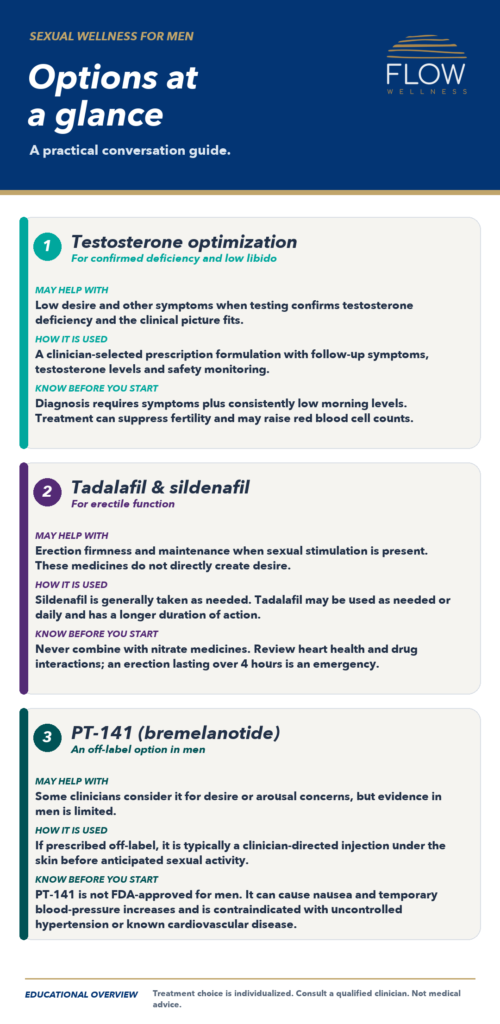
Testosterone Optimization and Libido
When a man reports that he still functions physically but no longer thinks about sex, wakes without morning erections, and feels flat overall, testosterone is the first place to look. Low testosterone reduces the drive that precedes arousal, and it also degrades the nitric oxide signaling that erections depend on, which means low testosterone can cause both categories of problem at once.
Restoring testosterone into a healthy physiologic range typically improves libido within three to six weeks, with erectile quality and energy following over the subsequent months. It also improves the response to erectile medications in men who previously found them inadequate, which is why we treat the hormone before concluding that a PDE5 inhibitor failed. Our full approach to male hormone therapy, including protocols, monitoring, and fertility considerations, is covered on the Flow Wellness testosterone replacement therapy page.
Tadalafil and Sildenafil for Erectile Function
Tadalafil and sildenafil are PDE5 inhibitors. They work by preventing the breakdown of cyclic GMP in penile tissue, which sustains smooth muscle relaxation and blood flow during arousal. Neither creates desire. Both require sexual stimulation to work, which is precisely why they disappoint men whose actual problem is low libido.
The practical difference between them is duration and rhythm. Sildenafil has a shorter window, typically around four to six hours, works best on an empty stomach, and suits planned intimacy. Tadalafil has a much longer half life and a window that can extend to a day and a half, which allows for spontaneity, and it is also available as a low dose daily option that removes timing from the equation entirely. Tadalafil is less affected by food. Side effect profiles differ slightly, with sildenafil more often producing visual changes and flushing and tadalafil more often producing back or muscle aching.
Neither is appropriate for men taking nitrates, and both require review of cardiovascular status, blood pressure medications, and alpha blocker use before prescribing. Low dose daily tadalafil also has a secondary benefit for men with urinary symptoms from benign prostatic hyperplasia, which makes it a useful choice for a subset of our patients.
The most important clinical point is that erectile dysfunction can be an early marker of vascular disease. New onset erectile dysfunction in a man in his forties or fifties warrants a cardiometabolic workup, not just a prescription. We do that workup.
PT-141 for Men
PT-141 is used off label in men, generally for those whose desire remains low despite optimized testosterone, or for men who do not tolerate or do not fully respond to PDE5 inhibitors. Because it acts centrally rather than vascularly, it addresses a different failure point and is occasionally combined with a PDE5 inhibitor under supervision.
Doctors for Erectile Dysfunction: What Doctor Should You See and What Treatments Actually Work?
Oxytocin and the Connection Piece
Oxytocin is released during touch, arousal, and orgasm, and it shapes the emotional dimension of intimacy: bonding, trust, closeness, and the felt sense of connection with a partner. It also plays a physiological role in orgasm and in smooth muscle contraction during climax.
Compounded oxytocin is prescribed in sublingual troche and intranasal forms with the goal of enhancing arousal, sensitivity, and emotional connection during intimacy. It is used for both men and women, sometimes alongside PT-141, and it appeals particularly to couples whose concern is less about mechanics and more about feeling present and connected.
The candid assessment is that human clinical trial data on compounded oxytocin for sexual function is limited. The physiology is well established, the clinical trial evidence is preliminary, and patient reported results are variable but sometimes striking. We treat it as an adjunct rather than a foundation, and we will tell you where the evidence stands before you decide.

The Piece Medication Cannot Fix
Sexual function is biological, psychological, and relational at the same time. Hormones and prescriptions address the biology. They do not address resentment, mismatched desire within a couple, performance anxiety, body image, trauma history, or the way that years of painful or disappointing sex teach the nervous system to brace rather than open.
Effective sexual medicine acknowledges this. When it is relevant, we recommend pelvic floor physical therapy for pain and pelvic muscle dysfunction, sex therapy or couples counseling for desire discrepancy and communication, and coordination with urology, gynecology, or mental health specialists. Patients who address both dimensions do consistently better than patients who address only one.
Sexual Wellness in Bend and Seattle
Flow Wellness sees patients in person at both locations, with telehealth follow up available across Oregon & Washington.
Bend patients tend to be an active population, and hormonal decline shows up here as much in training capacity and recovery as in the bedroom. Bend is also a small town where discretion matters and where several patients have told us they delayed care because they did not want to have the conversation locally. Our Bend clinic is built for unhurried, private appointments. Details and scheduling are on our hormone replacement therapy in Bend page.
Seattle patients more often come to us after a fragmented experience across a large health system, where sexual concerns were mentioned briefly in a fifteen minute visit and never revisited. Longer appointments and continuity with the same clinician change that. Information for Seattle patients is on our bioidentical hormone therapy in Seattle page.
Telehealth handles most follow up visits at both locations which makes ongoing care practical whether you live in Bend, Seattle, or somewhere in between.


Why people choose Flow Wellness for Sexual Wellness
If desire, arousal, comfort, or performance has changed and you have been told there is nothing to be done, that assessment was probably incomplete. A thorough evaluation usually finds something treatable.
Flow Wellness provides sexual wellness care for men and women in Bend, Oregon and Seattle, Washington, with telehealth follow up across Oregon & Washington.
 5.05.0Top Rated Wellness ClinicVerified by TrustindexTop Rated Wellness Clinic
- 5.0 Excellent rating Last 12 months
- New reviews collected regularly Recent review activity detected
- Leading Wellness Clinic Google Maps rating and review data
- Responds to customer reviews 100% response rate within 48 hours
- Verified by Trustindex Based on real customer reviews Learn more
Posted on Google
 Matt Batdorf5 days ago
Trustindex verifies that the original source of the review is Google.
Flow wellness is my best find since moving here. Fantastic if you’re looking for alternatives to the typical SSRI’s for mental health treatment. The whole staff is so friendly. Couldn’t recommend this place more.Posted on Google Jessica Duda11 days agoStopped in for an immunity IV. They are very nice and knowledgeable people. Great experience all around.Posted on Google
 Traci Donaca11 days agoThe staff is absolutely amazing. Both Tori and Olivia talked me through all of the service options and answered any questions I had. Never made me feel rushed. Offered some suggestions but never made me feel pressured. Offered me compression leg therapy and red light therapy while I received my IV. Rooms were clean and cozy, with a great view of the river. The team was so professional and kept checking in to make sure I was feeling ok. Overall, great experience. Highly recommend. Will definitely be booking again.Posted on Google
 Joseph D'Angelo20 days agoExtremely professional and genuinely concerned about your health. I’m seeing Allison Jones now and she is excellent!Posted on Google
 J S21 days agoExcellent service.Posted on Google
 Stacy Moch33 days ago
Trustindex verifies that the original source of the review is Google.
The Flow Wellness team is always willing to provide support without judgement.Posted on Google Shelley Lewis-Leander40 days agoI was extremely impressed with Kerry, she explained and answered my concerns and questions. I felt very comfortable and supportive.Posted on Google
 Amy Margolis75 days agoVery professional, knowledgeable and extremely personable. Did not feel rushed and answered all my questions.Posted on Google
 Jenn Masse81 days agoI had questions, Jill had answers. I am really appreciative of the time Jill took with me to understand my background, validate how I was feeling, evaluate various options for care and chat about next steps. Thank you!Posted on Google
 Marti OI'Doherty90 days agoHad a very positive experience with Kerry. She answered all the questions I had. We went over my body composition scan. Loved their format. Easy to read and understand. Recommend Flow Wellness out of Bend Oregon. So glad I am using them for my weight loss journey and new life style changes.Posted on Google
 Jordan Schwartz90 days agoVictoria is the absolute best!! I have been thrilled with my experience so far and the attentiveness of this company.Posted on Google
 The Club Salon92 days agoGreat customer service the whole staff, Dr. Jones very easy to talk to and prompt on calls. Thank you.Posted on Google
 Hanna Drozd92 days agoAlways a pleasure to have a conversation with them. They are very accurate and professionalPosted on Google
 Carol Manning102 days agoEveryone was so kind and very informative. I felt comfortable, feeling I was in good hands. I will be starting glp1 in a week, and so excited to see the results. Highly recommend!Posted on Google
 Colleen Lacter118 days agoThoughtful professionals. Extremely helpful!Posted on Google
 Gwendolyn Hamilton125 days agoVictoria was a dream to work with! I could not recommend her enough.Posted on Google
 Shelley Jones130 days agoFriendly and very knowledgeable staff!Posted on Google
 Marla Cummins133 days agoAll of the healthcare providers are very knowledgeable about the medication‘s being prescribed for weight loss. They also have a monthly publication that keeps us up-to-date on changes and new information regarding the medications. Kerry was my healthcare provider and she was Professional, empathetic, and knowledgeable. I was able to get a hold of her whenever I needed too with questions and concerns. She always responded promptly. I highly recommend Flow Wellness in Bend, Oregon.Posted on Google
 John Minor138 days agoGreat staff, comfortable environment, just signed up for monthy sessions ❤️Posted on Google
 Patrick Cabral162 days agoWhat a great business. I have been working with Flow Wellness for about 4 months and I find this company to be dedicated to the business of individual wellness. My treatment is managed by Holli Miller, FNP and it has been excellent. What I find refreshing is I have never been pushed on buying anything. Holli, like the Flow team provides me with options and recommendations which don't just focus on providing medicine but also lifestyle changes. They offer a host of services but again, never pushed. I feel comfortable in discussing my weight loss journey with the Flow team. If you read this, also check out the vast library of articles the Flow team have. I know weight loss is not just taking a shot and the Flow team with Holli don't just sell GLP-1s, they "provide" a plan and support for a successful wellness lifestyle. Highly recommend Flow to anyone. Even if you are just looking, there is NO pressure. Definitely worth a look.
Real Stories of Real Progress with Sexual Wellness
Honestly, this is the first time I’ve had a provider really take the time to listen. At Flow, I didn’t feel rushed or brushed off—they actually explained what was going on with my body and gave me a plan that makes sense. It felt like I was finally part of the conversation.
Andrea
I just did an initial intake and it was so lovely and thorough. I found the experience to be super welcoming, and gave me a lot of knowledge that I needed to make the decisions I wanted to make. Wonderful staff!
Angelina
That staff at Flow Wellness were very polite, professional and very informative. The facility is very nice as well. Definitely recommend them and their treatment plans.
Rod
Very positive first encounter with Flow Wellness. All the people I met were very courteous and attentive with a big smiles on their faces. I had my questions answered by Holly and I felt very comfortable. Happy to do business with flow wellness.
Dennis
They were very helpful and knowledgeable on the area that I was interested in. There’s never any pressure just facts and, when needed, sound consultation. Getting started was easy and some of the concerns I had were alleviated through the fact based consultation I had.
Ted
Super friendly and informative. Looking forward to continuing on my journey with your company. Thanks for everything.
Erin
I just had a great consultation at Flow. She answered all of my concerns and gave me as much time as I needed. She went over everything at length, and came up with the best option for me and my situation. Thanks!! I highly recommend!!
Karen
I can’t recommend Flow Wellness enough! They have completely balanced out my hormones, and I truly feel like a new person. I feel happy, healthy, and I’m so excited to have her on my medical team. Plus, the entire staff at Flow Wellness is incredibly kind, and I always feel so welcome. Five stars all the way!
Kathy
My friend recommended that I give Flow Wellness a try based on their positive experience. I'm so glad my friend was right. My provider has been great! They're always informative and patient, even with my many, many questions. So far my results have been great, and my overall experience even better!
Sean
I had a wonderful experience with Flow Wellness. Everyone has been very professional and understanding and of course kind.
Debra

Medically reviewed by Kevin Jones, MD – Medical Director, Flow Wellness
Member: Menopause Society, BHRT Training Academy
Last reviewed July 2026
Serving:
- Bend, Oregon (in-person)
- Seattle, Washington (in-person)
- Oregon & Washington (telehealth)
- California (limited telehealth)
Related Sexual Wellness Resources

What Are the Signs You Need Hormone Replacement Therapy?
Hormonal changes can affect far more than just hot flashes. Many women and men notice gradual shifts in energy, sleep, body composition, mood, recovery, libido,

PT-141 for Low Libido: A Different Approach to Sexual Wellness
Most treatments for sexual dysfunction focus on blood flow. PT-141 takes a different approach. Instead of working below the waist, PT-141 works in the brain,

Testosterone is The Overlooked Hormone That Could Change Your Life
The Hormone Everyone Talks About but Few Get Prescribed: Testosterone Most people think of testosterone as a men’s hormone, but both men and women naturally
Sexual Wellness FAQs
Is low libido a normal part of aging?
Common is not the same as normal. Some decline in frequency is expected with age, but distressing loss of desire almost always has identifiable contributors including hormone levels, thyroid function, sleep, medications, and stress. Most of them respond to treatment.
Will hormone therapy alone fix my sexual concerns?
For many patients, correcting the hormonal foundation resolves most of the problem. For others it resolves part of it, and targeted therapies such as PT-141, vaginal estrogen, arousal cream, or a PDE5 inhibitor address the remainder. We sequence rather than stack.
Is testosterone safe for women?
At physiologic female doses with appropriate monitoring, yes. International consensus guidance supports testosterone for postmenopausal women with distressing low desire and cautions against formulations that produce supraphysiologic levels. We dose conservatively and recheck levels.
Is PT-141 FDA approved?
Yes, for hypoactive sexual desire disorder in premenopausal women, approved in 2019. Use in postmenopausal women and in men is off label. We explain what the evidence supports for your specific situation.
Is scream cream FDA approved?
No. It is a compounded prescription preparation, and compounded products do not go through the FDA approval pathway. The individual ingredients have well established pharmacology, but the combination has not been tested in large randomized trials.
Is vaginal estrogen safe if I have a history of breast cancer?
This requires an individualized discussion in coordination with your oncologist. Current guidance notes that data in this population is limited, and treatment decisions should weigh symptom severity, alternatives, and your oncologist’s recommendations.
What is the difference between tadalafil and sildenafil?
Both are PDE5 inhibitors that support blood flow during arousal. Sildenafil acts over a shorter window and is affected by food. Tadalafil lasts substantially longer, is less affected by food, and is available as a low dose daily option.
Do I need to stop other medications to start treatment?
Not usually, but some medications interact meaningfully. Nitrates are a firm contraindication with PDE5 inhibitors. SSRIs, alpha blockers, and hormonal contraceptives all affect sexual function and require review. Bring a full medication list to your first visit.
How long before I notice a difference?
It depends on the therapy. PDE5 inhibitors and PT-141 work on demand. Testosterone improves libido within three to six weeks in men. Vaginal estrogen typically takes four to twelve weeks. Testosterone for women often takes eight to twelve weeks.
Do you see men and women, or only one?
Both. Sexual wellness is not a women’s issue or a men’s issue, and we frequently see both partners in a couple, separately.
Can I do this through telehealth?
Yes – telehealth is available in Oregon & Washington. Most follow up visits are handled by telehealth across Oregon, Washington, with local lab draws as needed.
Do you accept insurance?
Flow Wellness does not bill insurance, which allows for more flexibility in care and more personalized treatment plans. We do take FSA/HSA payments and can provide a superbill to give to your insurance company.
What types of hormone therapy does Flow Wellness offer?
At Flow Wellness, we customize hormone therapy based on your individual lab results, symptoms, and health goals. Treatment may include testosterone therapy, estrogen therapy, progesterone therapy, and supporting therapies like peptides or supplements. We offer multiple delivery methods – injections, creams, capsules, troches, or pellets – because different methods work better for different patients and lifestyles. The key difference in our approach is that we don’t prescribe a standard dose; we tailor treatment to your specific hormone levels and monitor your progress closely. Your provider will recommend the delivery method and treatment combination that aligns with your needs, schedule, and how your body responds.
How often are hormone levels monitored?
Flow Wellness monitors hormone therapy through follow-up visits, symptom reviews, and periodic lab testing. Monitoring helps providers adjust treatment safely and optimize results over time.
What makes Flow Wellness different from online hormone clinics?
Flow Wellness combines personalized provider care, ongoing communication, advanced wellness therapies, and comprehensive metabolic evaluations rather than focusing only on prescriptions. Patients also have access to body composition tracking and long-term wellness support.
Does Flow Wellness offer telehealth hormone appointments?
Yes. Flow Wellness offers both in-person and telehealth hormone consultations depending on patient location and medical eligibility. Flow Wellness clinics are located in Bend, Oregon & Seattle, Washington. Virtual visits available throughout Oregon & Washington.
Can hormone therapy be combined with weight loss or wellness programs?
Yes. Many patients combine hormone optimization with medical weight loss, peptide therapy, IV or injection therapy, peptide therapy, or body composition monitoring at Flow Wellness for a more comprehensive wellness approach.
Where is Flow Wellness located?
Flow Wellness operates physician-led clinics in two convenient locations:
Bend, Oregon
803 SW Industrial Way, Suite 201
Bend, OR 97702
Seattle, Washington
1818 Westlake Ave N, Suite 118
Seattle, WA 98109
Can I receive care via telehealth?
Yes. In addition to in-person visits at our Bend and Seattle clinics, we offer telehealth services across Oregon, Washington, and California. Telehealth is available for consultations, follow-ups, prescription management, and many of our treatments. Contact us to learn which services are available in your location.
Medical Disclaimer: The information provided in this article is for educational purposes only and should not be considered medical advice. At Flow Wellness, sexual wellness therapy is prescribed only after a comprehensive medical evaluation to determine whether treatment is appropriate. Every treatment plan is individualized based on your symptoms, medical history, laboratory results, and health goals. Always consult a qualified healthcare provider before making decisions about sexual wellness medications.
References
- The NAMS 2020 GSM Position Statement Editorial Panel. The 2020 genitourinary syndrome of menopause position statement of The North American Menopause Society. Menopause. 2020;27(9):976-992.
- American Urological Association, SUFU, AUGS. Genitourinary Syndrome of Menopause: AUA/SUFU/AUGS Guideline. 2025.
- Davis SR, Baber R, Panay N, et al. Global Consensus Position Statement on the Use of Testosterone Therapy for Women. J Clin Endocrinol Metab. 2019;104(10):4660-4666.
- Kingsberg SA, Clayton AH, Portman D, et al. Bremelanotide for the Treatment of Hypoactive Sexual Desire Disorder: Two Randomized Phase 3 Trials. Obstet Gynecol. 2019;134(5):899-908.
- Simon JA, Kingsberg SA, Portman D, et al. Long-Term Safety and Efficacy of Bremelanotide for Hypoactive Sexual Desire Disorder. Obstet Gynecol. 2019;134(5):909-917.