Grey market peptides — also spelled gray market — are peptides sold online outside regulated medical channels, usually labeled “research use only” or “not for human consumption.” That label isn’t a formality. It’s how sellers avoid FDA oversight and legal liability while shifting all the risk to you. These products skip the purity testing, sterility standards, and dosing verification that prescription peptides go through, and independent testing has repeatedly found them mislabeled, underdosed, overdosed, or contaminated.
If you’ve searched for peptides and landed on a site selling vials for a fraction of clinic pricing, you’ve found the grey market. Here’s what it actually is, what the real risks are, and where the law currently stands — as of July 2026, which matters more than usual right now.
Grey Market vs. Prescription Peptides: The Real Difference
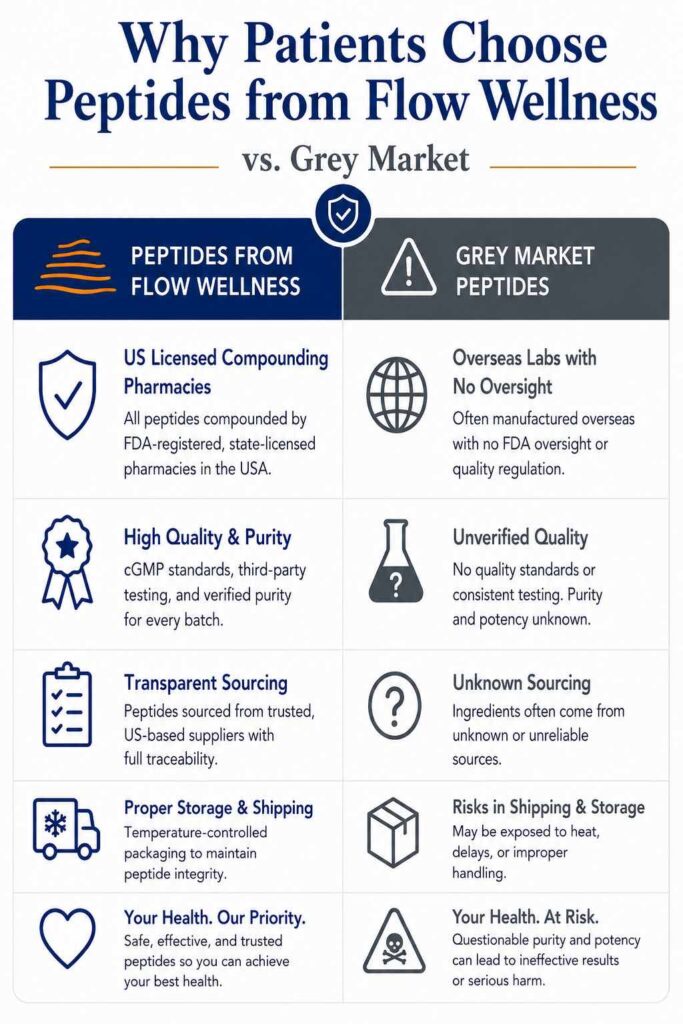
| Grey Market Peptides | Prescription / Compounded Peptides | |
|---|---|---|
| How it’s sold | Online, no prescription, “research use only” label | By prescription, through a licensed pharmacy |
| Who makes it | Often unregistered labs, frequently overseas | Licensed 503(a) compounding pharmacies, state-board regulated |
| Purity testing | Rarely; batch Certificates of Analysis often absent or unverifiable | Required; batch-tested for potency and impurities |
| Sterility | No guarantee; often mixed and bottled in uncontrolled conditions | Prepared under strict sterile compounding standards |
| Dosing accuracy | Unverified — actual content may differ substantially from the label | Verified concentration; you know what’s in the vial |
| Medical oversight | None. You are self-prescribing. | Clinical evaluation, dosing, monitoring, follow-up |
| If something goes wrong | No recourse. The “research only” label is the seller’s legal shield. | A licensed provider is accountable for your care |
| Legal status | A legal grey zone — hence the name | Lawful when the substance is eligible and properly prescribed |
Why It’s Called “Grey” Market
It isn’t the black market — nobody’s selling these out of a car trunk. Grey market sellers operate in the gap between legal medical prescribing and outright illegal sales.
The mechanism is the label. By marking a vial “research use only” or “not for human consumption,” a seller sidesteps the rules that govern drugs meant for people. They aren’t claiming to sell you medicine. They’re selling a research chemical, and what you do with it is legally your problem. In practice, of course, these products are marketed to consumers, discussed in fitness forums, and injected by people who are not researchers.
That label exists to protect the seller. Not you.
What Independent Testing Has Actually Found
The core issue with grey market peptides isn’t that peptides are dangerous. It’s that you have no way to know what’s in the vial. Testing of unregulated peptide products has repeatedly turned up:
- Wrong dose. Significantly more or significantly less active ingredient than the label states.
- Impurities and degradation byproducts from poor synthesis or poor storage.
- Bacterial contamination and endotoxins — a serious concern for anything you inject.
- Wrong compound entirely, or a different peptide than the one advertised.
- No verifiable Certificate of Analysis. Some sellers provide none; others provide COAs that can’t be traced to an accredited lab or to your specific batch.
Peptides are signaling molecules that act on hormone pathways, inflammation, and tissue repair. Small errors in what you’re actually injecting are not small errors in effect.
There’s a second problem that gets less attention: shipping and storage. Even a peptide that left the lab intact can degrade in a hot mailbox. Prescription peptides move through a cold chain. A package from an overseas seller does not.

The Legality Question — And Why July 2026 Matters
This is the part most articles get wrong, so here it is precisely.
A quick history. In September 2023, the FDA moved more than a dozen commonly compounded peptides into Category 2 of the 503A bulks list — a designation for substances with significant safety concerns, which effectively stopped licensed pharmacies from compounding them. Demand didn’t disappear. It moved to the grey market. That’s the honest through-line of this entire story: restricting the regulated supply pushed patients toward the unregulated one.
Where things stand now. In April 2026, the FDA removed twelve peptides from Category 2. That is not the same as approving them. It took them off the prohibited list without putting them on the permitted one — leaving them in a genuine regulatory limbo.
What’s happening in twelve days. On July 23–24, 2026, the FDA’s Pharmacy Compounding Advisory Committee (PCAC) meets to consider whether seven peptides should be added to the 503A Bulks List, which is the pathway that would make lawful compounding possible:
And here’s the part that matters for anyone waiting on this: in briefing documents posted ahead of the meeting, FDA reviewers recommended against adding all seven. The stated reasons were consistent — the substances are poorly characterized, human evidence of effectiveness is thin or absent, safety data is insufficient, and injectable use raises unaddressed immunogenicity concerns.
The committee’s recommendation is non-binding, and the FDA hasn’t issued a final determination. Formal rulemaking would take considerably longer even in the best case. But if you have been told these peptides are about to become widely and legally available, the current evidence points the other way — and no responsible clinic should be promising otherwise.
“But Everyone Online Says They’re Fine”
A few honest responses to the arguments you’ll see in forums:
“It’s the same molecule.” Not necessarily, and you can’t verify it. Two vials labeled tesamorelin are only the same if both were synthesized to the same standard, tested by an accredited lab, and stored correctly. Name on a label ≠ contents in a vial.
“Doctors just want to gatekeep.” Medical oversight isn’t a toll booth. It’s screening for the conditions and medications that make a given peptide a bad idea for you, getting the dose right, and catching problems early. What helps one person can harm another.
“There’s tons of research on recovery peptides” There’s animal research. Rigorous human clinical trials are essentially absent — which is precisely what the FDA’s own reviewers concluded this year. Compelling rodent data is not the same as evidence that it’s safe and effective in you.
“It’s way cheaper.” It is. That’s the whole appeal, and it’s a real consideration — peptide therapy is rarely covered by insurance. But the savings come from skipping exactly the steps that make a product safe: testing, sterility, oversight, accountability.
What About Grey Market GLP-1s and Retatrutide?
The same grey market that sells research peptides also sells GLP-1 medications — semaglutide, tirzepatide, and increasingly retatrutide, an investigational triple-agonist that is not FDA-approved and is not available through any legitimate prescription channel in the U.S.
Retatrutide deserves a specific warning. It’s in clinical trials. It is not approved. Every vial being sold online is, by definition, an unapproved investigational compound from an unregulated source, being self-administered without monitoring. If you are considering it, that’s the accurate framing.
For semaglutide and tirzepatide, there are legitimate paths — FDA-approved brands, and compounded versions where legally permitted. You do not need to buy from a grey market vendor to access GLP-1 therapy. Our medical weight loss program works through licensed pharmacies with a real prescription and real follow-up.
How Flow Wellness Approaches Peptides
We don’t prescribe, recommend, or support grey market peptides. What we do instead:
- Certified 503(a) compounding pharmacies only. No research-grade product, no reconstitute-it-yourself vials.
- A clinical evaluation first, so the question is whether a peptide is appropriate for you — not just whether you can get it.
- Verified dosing and concentration, so you know exactly what you’re injecting.
- Lab and body composition monitoring at our Bend and Seattle clinics to track how your body actually responds.
- Honesty about what we can’t offer. When a peptide isn’t legally available, we say so rather than routing you elsewhere.
We’re aware that last point costs us business. It’s still the right answer.
If you’re weighing peptide therapy, we’d rather talk you through the real options — including the ones we don’t provide — than watch you order a vial from a website. Book a consultation at our clinics in Bend, Oregon or Seattle, Washington, or by telehealth across California, Oregon, and Washington. You can also read our guide on what peptides actually are and how they differ from steroids.
Written and medically reviewed by Dr. Kevin Jones, MD, Board-Certified Emergency Medicine and Obesity Medicine
Medical Director, Flow Wellness
Last updated: July 2026
Frequently Asked Questions
What are grey market peptides?
Grey market peptides are peptides sold online outside regulated medical channels, typically labeled “research use only” or “not for human consumption.” They are sold without a prescription, without medical oversight, and without the purity, sterility, and dosing verification required of prescription peptides. The label allows sellers to avoid FDA regulation and legal liability.
Is it “grey market” or “gray market” peptides?
Both spellings refer to the same thing. “Gray” is the standard American spelling and “grey” the British one; in peptide discussions you’ll see them used interchangeably.
Are grey market peptides safe?
They carry real, avoidable risks. Independent testing has found unregulated peptide products with inaccurate dosing, impurities, bacterial contamination, and in some cases a different compound than advertised. Because there is no verified Certificate of Analysis, no sterility guarantee, and no medical oversight, there is no reliable way to know what you are injecting.
Are grey market peptides legal?
They occupy a legal grey zone — which is where the name comes from. Sellers avoid direct violation by labeling products “research use only,” but the products are widely marketed for and used in humans. Buying them is not the same as obtaining a lawfully prescribed, compounded peptide from a licensed pharmacy.
Why are grey market peptides labeled “research use only”?
The label lets the seller avoid the regulations that govern drugs intended for human use, and shifts legal responsibility to the buyer. It is a liability shield for the vendor, not a safety statement about the product.
Why do doctors warn against buying peptides online?
Because contamination, inaccurate dosing, degradation during shipping, and the absence of any medical screening or monitoring meaningfully increase the risk of harm — and if something goes wrong, there is no accountable party and no recourse.
Is retatrutide available by prescription?
No. Retatrutide is an investigational medication still in clinical trials and is not FDA-approved. It is not available through any legitimate U.S. prescription channel. Retatrutide sold online is an unapproved investigational compound from an unregulated source.
What is the difference between grey market and compounded peptides?
Compounded peptides are prepared by licensed 503(a) pharmacies against a valid prescription, under state pharmacy board oversight, with sterility and testing standards. Grey market peptides are sold without a prescription by unregulated sellers with no verifiable quality control. Compounded does not mean FDA-approved, but it does mean regulated, tested, and prescribed.
I already used a grey market peptide. What should I do?
Stop and talk to a licensed medical provider. Bring the product and any labeling with you. If you have symptoms such as fever, injection-site infection, unusual swelling, or anything that concerns you, seek medical care promptly. Providers are there to help you, not to judge you for what you’ve already taken.
References
- U.S. Food and Drug Administration. Pharmacy Compounding Advisory Committee Meeting, July 23–24, 2026.
- U.S. Food and Drug Administration. Bulk Drug Substances Nominated for Use in Compounding Under Section 503A.
- U.S. Food and Drug Administration. Compounding and the FDA: Questions and Answers.
Related Peptide Resources

Anti-Aging Copper Peptides
Topical Copper Peptides for Healthy Skin and Hair If you want firmer skin, a glowing complexion, and stronger hair, copper peptides are a must-have! At

The Peptide Revolution: Why These Small Molecules Are the Next Big Thing in Medicine
Remember when GLP-1s like semaglutide and tirzepatide completely changed the landscape of weight loss and metabolic health? Five years later, medicine is on the edge
Disclaimer: This blog post is for informational purposes only and should not be considered medical advice. Always consult with a healthcare provider for personalized medical advice.