No — peptides are not steroids. Peptides are short chains of amino acids that act as signaling molecules, telling your cells to perform a function like releasing growth hormone or repairing tissue. Anabolic steroids are lipid-based hormones derived from testosterone that enter cells and directly change gene expression to force muscle growth. They are different molecules, work through completely different mechanisms, carry very different side-effect profiles, and are regulated differently under U.S. law.
If you’ve researched peptide therapy, you’ve probably run into the assumption that peptides are “basically steroids.” It’s an easy mix-up — both are injected, both show up in fitness conversations, and both can influence muscle and recovery. But structurally and biologically, they aren’t the same category of compound at all. Here’s the clear, physician-reviewed breakdown.
Peptides vs. Steroids: Side-by-Side
| Peptides | Anabolic Steroids | |
|---|---|---|
| What they are | Short chains of amino acids (typically 2–50), the building blocks of proteins | Lipid-based compounds built on a four-ring carbon structure, derived from cholesterol/testosterone |
| How they work | Bind receptors on the cell surface and send a signal (“do this”) | Pass into the cell and bind receptors that directly alter gene expression |
| Effect style | Targeted, receptor-specific, short-acting | Broad, systemic, long-lasting |
| Typical use | Recovery, tissue repair, growth-hormone support, metabolic health, longevity | Rapid muscle mass and strength gains |
| Side-effect profile | Generally milder and more targeted; varies by peptide | Can be serious and sometimes permanent (hormonal shutdown, cardiovascular, liver, mood) |
| U.S. legal status | Varies by peptide; many available by prescription through compounding pharmacies | Schedule III controlled substances (Anabolic Steroid Control Act) |
| In competitive sport | Most banned by WADA for athletes in competition | All banned by WADA |
What Is a Peptide?
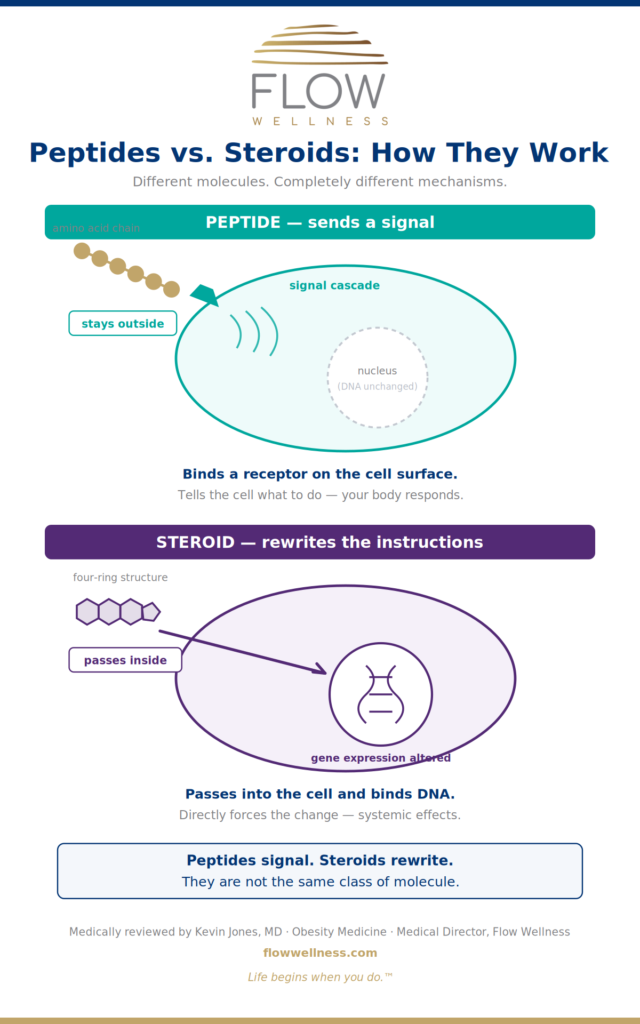
Peptides are short chains of amino acids linked by peptide bonds — essentially small proteins or protein fragments. Your body naturally produces thousands of them, where they act as signaling molecules: hormones, neurotransmitters, and messengers that regulate processes like tissue repair, inflammation, hormone release, and metabolism.
Therapeutic peptides work with these existing pathways. When a peptide binds to a receptor on a cell’s surface, it triggers a cascade of internal signals that nudge the cell to do something it already knows how to do — like release more of its own growth hormone. It’s a message, not a command that overwrites your physiology.
Insulin is the most familiar example: a 51-amino-acid peptide hormone, and the first synthetic peptide ever made, used to treat type 1 diabetes since 1923. GLP-1 medications like semaglutide and tirzepatide are also peptides.
What Is an Anabolic Steroid?
Anabolic-androgenic steroids (AAS) are synthetic derivatives of testosterone. Instead of signaling from the cell surface, they diffuse into the cell and bind androgen receptors in the cytoplasm. That steroid–receptor complex then moves into the nucleus and directly changes which genes are switched on or off, dramatically increasing protein synthesis in muscle.
Because androgen receptors exist throughout the body — muscle, bone, liver, heart, brain, and the hormonal (HPG) axis — steroids produce effects across many organ systems at once. That systemic reach is exactly why their results can be pronounced and why their risks are serious: testosterone suppression, testicular atrophy, adverse cholesterol changes, cardiovascular strain, liver stress (especially with oral forms), and mood effects are all documented in the research literature.
Why People Confuse the Two
The mix-up is understandable, and it comes from a few real overlaps:
- Same delivery method. Most peptides are injected subcutaneously with a small insulin syringe, and many steroids are injected too — so they look similar in practice.
- Similar goals in fitness circles. Both get used to support muscle, recovery, and fat loss, so they get lumped together in gym conversation.
- Some compounds blur the line. Growth-hormone secretagogues can affect size and strength and get mistaken for steroids, even though they work through signaling, not androgen receptors.
But shared goals and shared needles don’t make them the same class of molecule. The mechanism is the dividing line: peptides signal, steroids rewrite.
Are Peptides Safer Than Steroids?
In general, peptides tend to have a narrower, more targeted effect and a milder side-effect profile than anabolic steroids — but “milder than steroids” is not the same as “risk-free.” Side effects depend entirely on the specific peptide, the dose, and the source. Some peptides are well studied; others are not. And peptides purchased outside a medical channel — the “research use only” or grey-market products sold online — carry real risks of contamination, mislabeling, and inaccurate dosing because they skip sterility and purity testing.
This is the part that matters most: the safety of peptide therapy has less to do with peptides being “gentle” and more to do with whether a qualified clinician is choosing the right peptide, at the right dose, from a legitimate pharmacy, with monitoring. (For more on why source matters, see our guide on grey-market peptides.)
Are Peptides Legal?
It depends on the specific peptide. Anabolic steroids are Schedule III controlled substances in the U.S. and are illegal without a prescription for a legitimate medical purpose. Peptides occupy a more nuanced space: some are FDA-approved drugs (the GLP-1 medications, for example), many others are available by prescription through licensed 503(a) compounding pharmacies, and a number were reclassified by the FDA in recent years in ways that affect compounding eligibility. Regulations here change over time — which is one more reason to work through a medical provider rather than an online marketplace.
How Flow Wellness Approaches Peptide Therapy
At Flow Wellness, peptide therapy is delivered inside a structured medical framework — not handed out as a trend. That means a clinical evaluation, a plan built around your specific goals, pharmaceutical-grade peptides from certified 503(a) compounding pharmacies (never research-grade or reconstitute-it-yourself products), and ongoing monitoring with body composition scans at our Bend and Seattle clinics to track how your body actually responds.
Common categories we work with include growth-hormone-supporting peptides like Sermorelin and Tesamorelin, recovery and tissue-repair peptides, and metabolic support. Which peptide — if any — is appropriate depends entirely on your health history and goals, and that’s a decision your clinician makes with you.
If you’re weighing peptides against other options, or you’ve been told peptides are “just steroids,” we’re happy to walk you through the real differences. Explore our peptide therapy program, or book a consultation at our clinics in Bend, Oregon and Seattle, Washington, or via telehealth across California, Oregon, and Washington.
Frequently Asked Questions
Is a peptide a steroid?
No. Peptides are short chains of amino acids that act as signaling molecules on the cell surface, while anabolic steroids are hormone-based compounds derived from testosterone that enter cells and directly alter gene expression. They are different classes of molecules with different mechanisms, effects, and legal status.
Are peptides safer than steroids?
Peptides generally have a more targeted action and a milder side-effect profile than anabolic steroids, but they are not risk-free. Safety depends on the specific peptide, the dose, and — critically — whether it’s obtained from a legitimate pharmacy under medical supervision rather than an unregulated online source.
Do peptides build muscle like steroids?
Some peptides can support muscle recovery, tissue repair, and growth-hormone signaling, but they do this by encouraging your body’s own processes rather than forcing muscle growth the way anabolic steroids do. The effect is typically more gradual and less dramatic than steroids.
Are peptides legal in the U.S.?
It depends on the peptide. Some are FDA-approved medications, many are available by prescription through licensed compounding pharmacies, and regulatory status has shifted for several peptides in recent years. Anabolic steroids, by contrast, are Schedule III controlled substances and are illegal without a valid prescription.
Why do people think peptides are steroids?
Because both are commonly injected, both are used in fitness settings for muscle and recovery, and some compounds like growth-hormone secretagogues blur the line. Despite these surface similarities, peptides and steroids work through fundamentally different biological mechanisms.
Are GLP-1 medications like semaglutide peptides or steroids?
GLP-1 medications such as semaglutide and tirzepatide are peptides, not steroids. They work by binding GLP-1 (and, for tirzepatide, GIP) receptors to influence insulin secretion, appetite, and gastric emptying.
Is testosterone a peptide or a steroid?
Testosterone is a steroid hormone, not a peptide. It’s the basis for anabolic-androgenic steroids and works by binding androgen receptors and altering gene expression.
References
- WebMD. Peptides: Types, Applications, Benefits & Safety.
- Harvard Health Publishing. Peptides: What they are, potential benefits, and safety concerns.
- U.S. Drug Enforcement Administration. Anabolic Steroids — Controlled Substances Act, Schedule III.
- Fosgerau K, Hoffmann T. Peptide therapeutics: current status and future directions. Drug Discovery Today. 2015.
Peptides | Steroids |
|---|---|
Signal the body to perform specific functions | Directly replace or mimic hormones |
Amino acid based compounds | Hormone-based compounds |
Often used for recovery, longevity, and metabolic health | Primarily used for hormone replacement or muscle growth |
Generally more targeted effects | Broader systemic effects |
Lower risk of suppressing natural testosterone production | Can suppress natural testosterone production |
May support recovery, sleep, body composition, and healthy aging | Primarily known for strength and muscle-building effects |
If you’ve researched peptide therapy, you’ve probably run into the assumption that peptides are “basically steroids.” It’s an easy mix-up — both are injected, both show up in fitness conversations, and both can influence muscle and recovery. But structurally and biologically, they aren’t the same category of compound at all. Here’s the clear, physician-reviewed breakdown.
Peptides vs. Steroids: Side-by-Side
| Peptides | Anabolic Steroids | |
|---|---|---|
| What they are | Short chains of amino acids (typically 2–50), the building blocks of proteins | Lipid-based compounds built on a four-ring carbon structure, derived from cholesterol/testosterone |
| How they work | Bind receptors on the cell surface and send a signal (“do this”) | Pass into the cell and bind receptors that directly alter gene expression |
| Effect style | Targeted, receptor-specific, short-acting | Broad, systemic, long-lasting |
| Typical use | Recovery, tissue repair, growth-hormone support, metabolic health, longevity | Rapid muscle mass and strength gains |
| Side-effect profile | Generally milder and more targeted; varies by peptide | Can be serious and sometimes permanent (hormonal shutdown, cardiovascular, liver, mood) |
| U.S. legal status | Varies by peptide; many available by prescription through compounding pharmacies | Schedule III controlled substances (Anabolic Steroid Control Act) |
| In competitive sport | Most banned by WADA for athletes in competition | All banned by WADA |
What Is a Peptide?
Peptides are short chains of amino acids linked by peptide bonds — essentially small proteins or protein fragments. Your body naturally produces thousands of them, where they act as signaling molecules: hormones, neurotransmitters, and messengers that regulate processes like tissue repair, inflammation, hormone release, and metabolism.
Therapeutic peptides work with these existing pathways. When a peptide binds to a receptor on a cell’s surface, it triggers a cascade of internal signals that nudge the cell to do something it already knows how to do — like release more of its own growth hormone. It’s a message, not a command that overwrites your physiology.
Insulin is the most familiar example: a 51-amino-acid peptide hormone, and the first synthetic peptide ever made, used to treat type 1 diabetes since 1923. GLP-1 medications like semaglutide and tirzepatide are also peptides.
What Is an Anabolic Steroid?
Anabolic-androgenic steroids (AAS) are synthetic derivatives of testosterone. Instead of signaling from the cell surface, they diffuse into the cell and bind androgen receptors in the cytoplasm. That steroid–receptor complex then moves into the nucleus and directly changes which genes are switched on or off, dramatically increasing protein synthesis in muscle.
Because androgen receptors exist throughout the body — muscle, bone, liver, heart, brain, and the hormonal (HPG) axis — steroids produce effects across many organ systems at once. That systemic reach is exactly why their results can be pronounced and why their risks are serious: testosterone suppression, testicular atrophy, adverse cholesterol changes, cardiovascular strain, liver stress (especially with oral forms), and mood effects are all documented in the research literature.
Why People Confuse the Two
The mix-up is understandable, and it comes from a few real overlaps:
- Same delivery method. Most peptides are injected subcutaneously with a small insulin syringe, and many steroids are injected too — so they look similar in practice.
- Similar goals in fitness circles. Both get used to support muscle, recovery, and fat loss, so they get lumped together in gym conversation.
- Some compounds blur the line. Growth-hormone secretagogues can affect size and strength and get mistaken for steroids, even though they work through signaling, not androgen receptors.
But shared goals and shared needles don’t make them the same class of molecule. The mechanism is the dividing line: peptides signal, steroids rewrite.
Are Peptides Safer Than Steroids?
In general, peptides tend to have a narrower, more targeted effect and a milder side-effect profile than anabolic steroids — but “milder than steroids” is not the same as “risk-free.” Side effects depend entirely on the specific peptide, the dose, and the source. Some peptides are well studied; others are not. And peptides purchased outside a medical channel — the “research use only” or grey-market products sold online — carry real risks of contamination, mislabeling, and inaccurate dosing because they skip sterility and purity testing.
This is the part that matters most: the safety of peptide therapy has less to do with peptides being “gentle” and more to do with whether a qualified clinician is choosing the right peptide, at the right dose, from a legitimate pharmacy, with monitoring. (For more on why source matters, see our guide on grey-market peptides.)
Are Peptides Legal?
It depends on the specific peptide. Anabolic steroids are Schedule III controlled substances in the U.S. and are illegal without a prescription for a legitimate medical purpose. Peptides occupy a more nuanced space: some are FDA-approved drugs (the GLP-1 medications, for example), many others are available by prescription through licensed 503(a) compounding pharmacies, and a number were reclassified by the FDA in recent years in ways that affect compounding eligibility. Regulations here change over time — which is one more reason to work through a medical provider rather than an online marketplace.
How Flow Wellness Approaches Peptide Therapy
At Flow Wellness, peptide therapy is delivered inside a structured medical framework — not handed out as a trend. That means a clinical evaluation, a plan built around your specific goals, pharmaceutical-grade peptides from certified 503(a) compounding pharmacies (never research-grade or reconstitute-it-yourself products), and ongoing monitoring with body composition scans at our Bend and Seattle clinics to track how your body actually responds.
Common categories we work with include growth-hormone-supporting peptides like Sermorelin and Tesamorelin, recovery and tissue-repair peptides, and metabolic support. Which peptide — if any — is appropriate depends entirely on your health history and goals, and that’s a decision your clinician makes with you.
If you’re weighing peptides against other options, or you’ve been told peptides are “just steroids,” we’re happy to walk you through the real differences. Explore our peptide therapy program, or book a consultation at our clinics in Bend, Oregon and Seattle, Washington, or via telehealth across California, Oregon, and Washington.
Frequently Asked Questions
Is a peptide a steroid?
No. Peptides are short chains of amino acids that act as signaling molecules on the cell surface, while anabolic steroids are hormone-based compounds derived from testosterone that enter cells and directly alter gene expression. They are different classes of molecules with different mechanisms, effects, and legal status.
Are peptides safer than steroids?
Peptides generally have a more targeted action and a milder side-effect profile than anabolic steroids, but they are not risk-free. Safety depends on the specific peptide, the dose, and — critically — whether it’s obtained from a legitimate pharmacy under medical supervision rather than an unregulated online source.
Do peptides build muscle like steroids?
Some peptides can support muscle recovery, tissue repair, and growth-hormone signaling, but they do this by encouraging your body’s own processes rather than forcing muscle growth the way anabolic steroids do. The effect is typically more gradual and less dramatic than steroids.
Are peptides legal in the U.S.?
It depends on the peptide. Some are FDA-approved medications, many are available by prescription through licensed compounding pharmacies, and regulatory status has shifted for several peptides in recent years. Anabolic steroids, by contrast, are Schedule III controlled substances and are illegal without a valid prescription.
Why do people think peptides are steroids?
Because both are commonly injected, both are used in fitness settings for muscle and recovery, and some compounds like growth-hormone secretagogues blur the line. Despite these surface similarities, peptides and steroids work through fundamentally different biological mechanisms.
Are GLP-1 medications like semaglutide peptides or steroids?
GLP-1 medications such as semaglutide and tirzepatide are peptides, not steroids. They work by binding GLP-1 (and, for tirzepatide, GIP) receptors to influence insulin secretion, appetite, and gastric emptying.
Is testosterone a peptide or a steroid?
Testosterone is a steroid hormone, not a peptide. It’s the basis for anabolic-androgenic steroids and works by binding androgen receptors and altering gene expression.
References
- WebMD. Peptides: Types, Applications, Benefits & Safety.
- Harvard Health Publishing. Peptides: What they are, potential benefits, and safety concerns.
- U.S. Drug Enforcement Administration. Anabolic Steroids — Controlled Substances Act, Schedule III.
- Fosgerau K, Hoffmann T. Peptide therapeutics: current status and future directions. Drug Discovery Today. 2015.
Last updated: July 2026
Author: Allison Jones, F-NP
Medically reviewed by Dr. Kevin Jones, MD
Board Certified in Emergency & Obesity Medicine. Medical Director, Flow Wellness
Related Resources

Testosterone Replacement Therapy (TRT) for Men in OR & WA
Are You Ready to Feel Like Yourself Again? Testosterone Replacement Therapy (TRT) for Men in Bend, Seattle, and via telehealth in OR & WA Testosterone

What Are Peptides? A Simple Guide You Can Understand
This Is Your Simple Guide To Learning About Peptides At Flow Wellness, we explain peptides in a way that makes sense in real life. They’re

Testosterone is The Overlooked Hormone That Could Change Your Life
The Hormone Everyone Talks About but Few Get Prescribed: Testosterone Most people think of testosterone as a men’s hormone, but both men and women naturally