
Your regular doctor’s annual blood work likely includes basic metabolic panels, cholesterol screening, and maybe thyroid-stimulating hormone (TSH). But if you’re experiencing fatigue, weight gain, mood changes, or declining sexual function, those standard tests often miss the root cause. At Flow Wellness, we take a different approach. We measure comprehensive hormone levels, metabolic markers, and body composition that conventional medicine rarely checks – giving us the detailed picture necessary to create truly personalized hormone replacement therapy.
What Your Regular Doctor Tests (and What They Miss)
Most primary care physicians follow a one-size-fits-all testing approach. During your annual physical, you’ll likely receive:
A basic metabolic panel (CMP) that measures glucose, electrolytes, and kidney/liver function, but this doesn’t assess hormone levels or metabolic dysfunction. Thyroid-stimulating hormone (TSH), which is useful as a screening tool but doesn’t reveal the full picture of thyroid function. Total cholesterol and lipid panels, important for cardiovascular risk but disconnected from hormonal health. Hemoglobin A1c or fasting glucose, which can indicate diabetes risk but miss early-stage insulin resistance.
This testing framework works well for catching acute illness or end-stage disease. But it’s insufficient for people navigating hormonal transition, weight management challenges, or energy deficits. Standard panels are designed for speed and cost efficiency, not precision diagnosis. As a result, many patients walk away with “normal” lab results while continuing to experience very real symptoms.
The Flow Wellness Difference: Comprehensive Hormone Testing
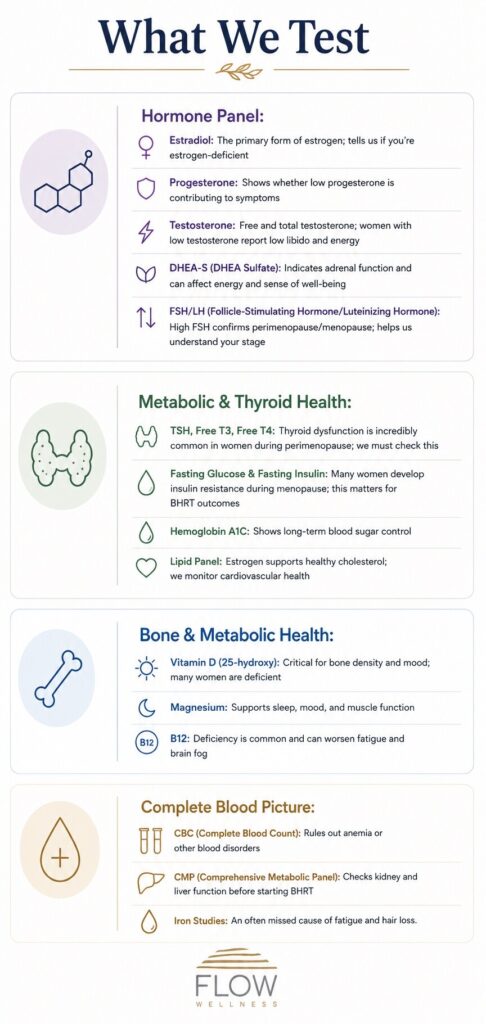
At Flow Wellness, our approach starts with comprehensive hormone assessment. Instead of checking only TSH, we measure free T3, free T4, and reverse T3 to understand thyroid function at the tissue level. We test total and free testosterone to differentiate between production and bioavailability issues. We measure estradiol, progesterone, and their ratio rather than assuming one hormone is the culprit.
Beyond sex hormones, we assess adrenal function through cortisol patterns and DHEA-S levels. We evaluate follicle-stimulating hormone (FSH) and luteinizing hormone (LH) to understand the brain-hormone communication axis. We measure prolactin, sex hormone-binding globulin (SHBG), and other modulatory hormones that regular doctors overlook but that dramatically influence how your body uses and responds to hormones.
For our testosterone replacement therapy (TRT) patients, this means we’re not just checking “Is testosterone low?” but “Why is it low, how much is active in your system, and how is your estradiol converting?” This precision allows us to dial in the exact protocol that works for your unique endocrine system.
Metabolic Testing Beyond Glucose and Cholesterol
Your regular doctor’s metabolic panel is a snapshot. Flow Wellness digs deeper into how your metabolism actually works.
We evaluate inflammation markers including high-sensitivity C-reactive protein (hs-CRP), which predicts cardiovascular disease independent of cholesterol levels. Many patients discover they have significant inflammatory burden that was never addressed.
For hormone therapy patients, these metabolic markers matter profoundly. Hormones influence glucose disposal and fat distribution. Poor metabolic health can blunt your response to HRT. By tracking these markers, we optimize both hormone dosing and lifestyle interventions for maximum benefit.
Body Composition Analysis: Moving Beyond BMI
Here’s what most doctors know: weight and BMI. Here’s what they miss: muscle, bone density, visceral fat, and metabolic rate.
BMI is a crude population-level tool that conflates muscle mass with fat mass. You could have excellent BMI but high visceral fat (fat surrounding internal organs) driving heart disease risk. Or strong muscle mass that doesn’t register on a scale because it’s heavier than fat. Flow Wellness uses bioelectrical impedance analysis (BIA) and DEXA scanning to measure:
Fat mass and body fat percentage, showing not just how much fat you carry but where it’s distributed. Lean mass and muscle mass, critical metrics because every pound of muscle increases your resting metabolic rate and improves glucose disposal. Visceral adipose tissue (VAT), the inflammatory fat that predicts metabolic syndrome and cardiovascular disease far better than total weight. Bone density, especially important for women entering menopause or on hormone therapy, where bone health is a treatment priority.
This data transforms your monitoring. You might lose no weight on the scale but gain muscle and lose visceral fat, a massive win for your health. You might discover that your “normal” BMI hides metabolic vulnerability that hormone therapy plus strength training can reverse. For HRT and BHRT patients, body composition tracking is how we actually measure whether the therapy is working and adjusting appropriately.
The Case for Comprehensive Hormone Panel Timing and Cycle Awareness
Conventional doctors often order hormone tests whenever patients call. Flow Wellness knows better. Timing matters enormously, especially for women.
For premenopausal women, we test on specific days of your cycle because estrogen and progesterone fluctuate predictably. Day 3 captures baseline estrogen and FSH to assess ovarian reserve. Days 19-22 capture mid-luteal progesterone, when levels should peak. Testing at the wrong time creates misleading results that lead to incorrect treatment decisions.
For perimenopausal women, hormone fluctuations are the entire story. We track how FSH is rising as estrogen drops, how symptoms map to these shifts, and how personalized BHRT can restore stability. For women on bioidentical hormone replacement therapy, we retest after 4-6 weeks of a new dose to ensure levels are in therapeutic range without over-replacement.
For men on testosterone replacement therapy, we measure testosterone 3-7 days after injection (to capture peak levels) and counsel on injection timing relative to testing. We evaluate estradiol conversion to ensure it’s not climbing into problematic ranges. We check LH and FSH if natural production matters to the patient.
This level of precision is standard in functional and integrative medicine. It’s rare in conventional primary care, which is why so many patients feel like their symptoms are being dismissed: their labs truly do look “normal” by outdated standards.
Metabolic Markers That Predict Disease Before Symptoms Appear
Flow Wellness excels at catching metabolic dysfunction early, before irreversible damage occurs. Several markers are particularly revealing:
hs-CRP above 1.0 mg/L indicates systemic inflammation linked to heart disease, metabolic syndrome, and accelerated aging. It’s often completely overlooked by conventional screening. Homocysteine above 10 nmol/L suggests cardiovascular and cognitive risk; B vitamins and methylation support can reduce it. Vitamin D below 30 ng/mL is nearly universal in people seeking HRT and independently linked to hormonal imbalance and poor treatment response.
For testosterone patients specifically, we monitor metabolic markers because TRT improves body composition and insulin sensitivity.
Nutrient and Micronutrient Assessment
Hormones don’t work in isolation. They require cofactors. Your regular doctor doesn’t check most of these.
We measure vitamin D (25-OH), which is both a hormone and a micronutrient with 1,000+ receptor sites throughout your body. Low vitamin D blunts immune function, worsens mood, impairs bone health, and reduces HRT efficacy. We assess B vitamins including B12, folate, and methylation capacity because these are critical for hormone metabolism and neurotransmitter synthesis. Low magnesium compromises sleep, stress resilience, and muscle function. Iron and ferritin levels matter for women who have heavy periods before HRT or who are considering estrogen therapy (which interacts with iron absorption).
Women on HRT often assume their symptoms are hormonal when actually they’re nutrient-deficient. Flow Wellness solves this by testing comprehensively and recommending targeted supplementation alongside hormone therapy.
How Flow Wellness Uses Comprehensive Testing to Customize Treatment
The entire point of detailed testing is better treatment. Here’s how it works in practice:
For women on BHRT: If you have low progesterone but normal estradiol, we recommend progesterone-first dosing. If estradiol is high and DHEA-S is low, we might delay additional estrogen while supporting adrenal function. If your thyroid panel shows subclinical hypothyroidism, we address it before escalating hormone doses, since thyroid dysfunction can mimic and worsen estrogen dominance symptoms.
For men on TRT: If free testosterone is low but total testosterone is “normal,” SHBG elevation is the problem—binding hormone, not production. If estradiol is climbing into female range, we adjust dose or add an aromatase inhibitor. If metabolic markers show worsening insulin resistance despite TRT, we investigate liver function and cortisol patterns because chronic stress can blunt TRT benefits.
For patients on GLP-1 therapy for weight loss: Comprehensive metabolic testing tells us whether weight loss is driven by appetite suppression alone or by true metabolic improvement. We track visceral fat loss, preserved lean mass, and improvements in insulin resistance. We monitor vitamin levels because GLP-1 reduces absorption of B12, iron, and other nutrients.
This feedback loop is impossible with standard testing. Your regular doctor sees “your numbers improved” and stops looking. Flow Wellness sees nuance and adjusts constantly.
This isn’t standard for conventional medicine. It’s standard for effective hormone replacement therapy.
Medically reviewed by Kevin Jones, MD – Medical Director, Flow Wellness
Member: Menopause Society, BHRT Training Academy
Updated: June 2026
Feel like yourself again at Flow Wellness

When your hormones are more balanced, things tend to feel more consistent.
Energy stabilizes. Sleep improves. You feel more clear, more capable, and more like yourself again.
If you’re looking for hormone replacement therapy provider in Bend, Seattle, or telehealth in Oregon or Washington, you can start with a consultation and decide what the right next step looks like.
Flow Wellness FAQ on Comprehensive Hormone Testing
Q: Do I need all these tests, or just a few? A: Your testing should be customized to your symptoms, goals, and health history. If you’re considering hormone therapy, a comprehensive baseline is essential. If you’ve been stable on HRT for years, you might test annually rather than every few months. Flow Wellness evaluates each patient individually.
Q: Why isn’t comprehensive testing standard at my regular doctor’s office? A: Cost, time, and liability. Comprehensive testing is more expensive and takes longer to interpret. Conventional medicine prioritizes screening for acute illness and common conditions, not optimization or early disease prevention. Functional and integrative medicine—the approach Flow Wellness uses—prioritizes understanding how your body works as a system.
Q: Can I use my insurance to cover comprehensive hormone testing? A: Some insurance plans cover hormone testing when it’s medically necessary (e.g., diagnosing hypogonadism or menopause), but won’t cover micronutrient testing or body composition analysis. Flow Wellness works with your insurance when possible and offers self-pay options for out-of-pocket testing. Discuss costs upfront during your consultation.
Q: How often should I retest once I start hormone therapy? A: Initial retesting is typically 4-6 weeks after starting or adjusting a hormone dose to ensure levels are in therapeutic range. After that, many patients retest every 6-12 months for monitoring. Cortisol and metabolic markers may be tested annually unless symptoms change. Your Flow Wellness provider will recommend a timeline based on your specific protocol.
Q: Is bioelectrical impedance analysis (BIA) accurate compared to DEXA? A: BIA is non-invasive, quick, and highly accessible (accuracy within 2-3% of DEXA in most cases). DEXA is the gold standard for bone density and slightly more precise for body composition. Flow Wellness uses BIA for it’s ease of use.
Q: What if my metabolic markers are “normal” but I have HRT symptoms? A: Normal by conventional ranges doesn’t mean optimal for your goals. Flow Wellness interprets labs using functional medicine ranges, which are narrower and more predictive of health optimization. A TSH of 3.0 is “normal” conventionally but may indicate subclinical hypothyroidism functionally. We look for optimization, not just absence of disease.
Q: Can hormone testing be done via mail-order kits? A: Some hormone testing can be (particularly DHEA-S, cortisol, and sex hormones), but interpretation matters enormously. Flow Wellness recommends in-office testing for your initial evaluation because proper phlebotomy timing, cycle-day awareness, and clinical context are critical. Follow-up monitoring can sometimes use home testing if your provider approves.
Q: Does comprehensive testing work for telehealth patients? A: Yes. Flow Wellness serves patients across Oregon, Washington, and California via telehealth. We coordinate lab testing through local draw sites or mail-in kits, review results remotely, and adjust your protocol via secure messaging and video. You get the same comprehensive, data-driven approach regardless of whether you see us in Bend or Seattle or via telehealth.
Q: If I’m only on BHRT for menopause, why do I need metabolic testing? A: Because menopause and metabolic health are deeply intertwined. Declining estrogen worsens insulin resistance, accelerates visceral fat gain, and increases cardiovascular risk. Testing reveals whether your BHRT is improving metabolic health or whether additional interventions (nutrition, exercise, stress management) are needed. It’s the difference between symptom relief and true disease prevention.
References
- Journal of Clinical Endocrinology & Metabolism. “DHEA-S as a marker of hypothalamic-pituitary-adrenal axis function.” Accessed via PMC.
- Access Med Lab. “Most Commonly Ordered Functional Medicine Hormone Tests for Men.” Published January 19, 2026. https://blog.accessmedlab.com/most-commonly-ordered-functional-medicine-mens-hormone-labs
- Root Functional Medicine. “Functional Medicine Lab Testing.” Updated June 2026. https://rootfunctionalmedicine.com/functional-medicine-lab-testing
- CT Hormone Therapy. “Conventional vs Functional Lab Testing: Know the Difference.” Published November 26, 2022. https://cthormonetherapy.com/conventional-vs-functional-lab-testing/
- Superpower. “Body Composition Biomarkers: Understanding Lean Mass, Fat Distribution, and Metabolic Health.” https://superpower.com/library/body-composition-biomarkers
Related Hormone Resources

Body Composition Scans in Bend & Seattle
Advanced Wellness Tracking at Flow Wellness Understand What Your Weight Is Really Telling You Schedule My Body Composition Scan The number on the scale only

Hormone Therapy (HRT/TRT) for Men & Women in the Pacific Northwest
Hormone Replacement Therapy In Bend & Seattle. Also serving Oregon & Washington via telehealth Feel more like yourself again. Something feels off, but it’s hard
What Labs Are Commonly Included in Our Baseline Hormone Assessment—And Why?
If you’re considering bioidentical hormone replacement therapy (BHRT), you might be wondering: Why are there so many lab tests before getting started? At Flow Wellness,
Medical Disclaimer: The information provided in this article is for educational purposes only and should not be considered medical advice. At Flow Wellness, hormone replacement therapy is prescribed only after a comprehensive medical evaluation to determine whether treatment is appropriate. Every treatment plan is individualized based on your symptoms, medical history, laboratory results, and health goals. Always consult a qualified healthcare provider before making decisions about hormone therapy.