
Progesterone is a neurosteroid that crosses the blood-brain barrier and converts to allopregnanolone, a compound that enhances GABA, your brain’s primary calming neurotransmitter. This GABA activation reduces racing thoughts, decreases sleep latency (time to fall asleep), increases deep sleep, and reduces nighttime awakenings. When progesterone declines during perimenopause or menopause, this natural sleep support disappears, often resulting in the characteristic fragmented sleep, 2-3 AM wakings, and difficulty falling back asleep. Oral micronized progesterone at bedtime effectively restores this neurological support. Flow Wellness provides comprehensive evaluation of whether progesterone is appropriate for your sleep issues and individualizes your dosing, timing, and delivery method for maximum effectiveness.
Understanding Progesterone as a Neurosteroid, Not Just a Reproductive Hormone
Most women think of progesterone as a hormone for menstrual cycles and pregnancy. This is accurate but incomplete. Progesterone is also a neurosteroid—a hormone with profound effects on brain chemistry and nervous system function. This distinction is clinically important because it explains why progesterone at bedtime can profoundly transform sleep quality in perimenopausal and menopausal women.
Your brain produces receptors for progesterone throughout regions regulating sleep, mood, anxiety, and emotional processing. When progesterone levels are adequate—as they are in women of reproductive age during the luteal phase of the menstrual cycle—these receptors are continuously bathed in a calming, sleep-supporting hormone. Your nervous system has benefited from this neurological support for decades.
Then perimenopause arrives. Progesterone production becomes erratic early in the transition, and by menopause, progesterone plummets to nearly zero. Your brain loses a significant source of natural calming support. The result? Lighter sleep, more frequent awakenings, less restorative sleep, and that distinctive menopause sleep problem: waking at 2-3 AM unable to fall back asleep.
Understanding progesterone as a neurosteroid reframes the conversation: you’re not treating a hormone deficiency in isolation. You’re restoring neurological calm—the same calm your brain had naturally throughout your reproductive years.
The Mechanism: How Progesterone Creates Calm Through GABA
The science of progesterone and sleep hinges on a specific neurological mechanism: GABA activation.
GABA (gamma-aminobutyric acid) is your brain’s primary inhibitory neurotransmitter – essentially the “brake pedal” for nervous system activation. When GABA is functioning well, your brain quiets down, anxiety dissolves, racing thoughts cease, and sleep becomes possible. When GABA is insufficient, your nervous system stays activated, your mind races, and sleep is elusive.
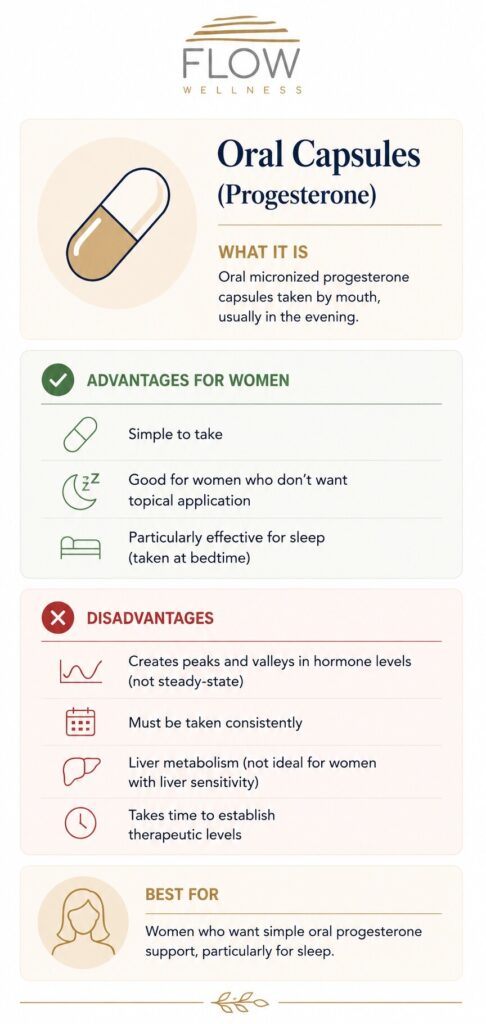
Progesterone enhances GABA through a specific pathway. When you take oral micronized progesterone, your liver metabolizes it into neuroactive metabolites, primarily allopregnanolone. This metabolite crosses the blood-brain barrier and binds to GABA-A receptors, acting as what’s called a positive allosteric modulator. This means it makes GABA more effective at its job – calming the brain.
The receptor mechanism is identical to how benzodiazepines (prescription sleep medications like lorazepam) work. In fact, your brain has been receiving this benzodiazepine-like calming effect naturally throughout your reproductive years via progesterone. When you restore progesterone levels through supplementation, you’re restoring that endogenous calming pathway.
This mechanism explains several clinical observations: why oral progesterone often feels sedative and relaxing, why topical creams (which don’t undergo hepatic metabolism) don’t produce the same sleep effect, why timing at bedtime is optimal, and why the effects develop within 30-60 minutes of taking the dose.
Why Oral Micronized Progesterone Works Best for Sleep
Progesterone can be delivered through multiple routes: oral capsules, topical creams, gels, intrauterine devices, and vaginal administration. However, only oral micronized progesterone consistently produces the sleep benefits you’re reading about.
The reason is the first-pass effect. When you swallow oral progesterone, it travels to the liver before entering general circulation. The liver metabolizes it into allopregnanolone and other neuroactive metabolites. These metabolites have high affinity for GABA-A receptors and cross the blood-brain barrier readily.
Topical creams and gels bypass the liver entirely, entering circulation directly through the skin. This means they avoid the first-pass metabolism that creates the sleep-supporting metabolites. While creams may provide some hormonal support and help with other symptoms like breast tenderness or mild mood swings, they don’t reliably produce the sedative neurological effects of oral progesterone.
For women seeking progesterone specifically for sleep support, this distinction matters enormously. Oral micronized progesterone at bedtime is the evidence-based choice. Topical options may be appropriate for other goals but should not be expected to deliver the same sleep benefits.
Progesterone Dosing for Sleep: What Research Shows
The most studied dose for sleep benefit is 300 mg of oral micronized progesterone taken at bedtime. This dose consistently appears in clinical research as effective for:
Reducing sleep latency (time to fall asleep), typically by 15-30 minutes Increasing deep sleep (slow-wave sleep) by approximately 15 percent Reducing wakefulness during the night Fewer middle-of-the-night awakenings, particularly the characteristic 2-3 AM wake pattern Improved subjective sleep quality and morning refreshment
However, 300 mg is not a universal starting dose. The North American Menopause Society notes that some women benefit at 100 mg, while others need the full 300 mg. Dosing is individualized based on:
- Severity of sleep disturbance
- Body weight and metabolism
- Sensitivity to sedation (some women experience excessive grogginess at higher doses)
- Whether progesterone is being used for sleep alone or as part of broader hormone therapy
- Other symptoms (hot flashes, night sweats, mood) that may benefit from higher doses
Flow Wellness typically starts at 100-200 mg and adjusts based on your response. If sleep improves at 100 mg, that’s your optimal dose. If not, we increase gradually. The goal is the lowest effective dose that improves your sleep without causing excessive next-day grogginess.
Taking Progesterone for Sleep: Timing, Food, and Timeline
When to Take It
Oral micronized progesterone should be taken 30-60 minutes before bed. This timing aligns with when the medication reaches peak brain concentration, as you’re lying down to sleep. Taking it too early (morning or afternoon) will cause drowsiness when you need to be alert. Taking it at random times defeats the sleep purpose.
Food Matters
Absorption is better with food – particularly a light meal or snack containing some fat. Taking progesterone on an empty stomach results in more variable absorption and sometimes stomach upset. A small snack – yogurt, a handful of nuts, cheese and crackers – is ideal 30 minutes before taking your bedtime dose.
What to Expect Week by Week
Week 1: Many women feel drowsiness within 30-60 minutes of taking progesterone. Sleep onset may be noticeably faster. Some women wake the first few mornings feeling slightly groggy – this often resolves as your body adjusts. Sleep architecture changes are measurable on night one.
Weeks 2-3: The sedative effect stabilizes. Grogginess usually resolves. Sleep quality continues improving. You may notice waking less frequently during the night. The restorative quality of sleep noticeably improves.
Weeks 4-8: By this point, you’ve adapted to the medication. Sleep benefits are consistent. If morning grogginess persists beyond week 3, dose reduction often helps. Many women report “sleeping through the entire night for the first time in years” by week 4-8.
Months 2-3+: Sleep improvements continue or further stabilize. Some women report benefits continue to improve through month 3. This is sustainable therapy -benefits don’t diminish over time with ongoing use.
Progesterone Dosing in Perimenopause Versus Menopause
Sleep disruption from low progesterone presents differently in perimenopause versus established menopause, which affects how progesterone is dosed.
Perimenopause
During perimenopause (the 4-10 year transition before your final menstrual period), hormone levels don’t just decline – they fluctuate erratically. Some months, progesterone is adequate and sleep is fine. Other months, progesterone crashes and sleep falls apart. Estradiol is often elevated and highly variable, sometimes even higher than during reproductive years.
For perimenopausal women with persistent sleep disturbance, continuous progesterone at bedtime (every night) often works better than cyclic dosing (14 days on, 14 days off). If you’re still menstruating, your provider may recommend starting on a cycle (days 14-27 of your menstrual cycle) and shifting to nightly if sleep remains fragmented. Dosing typically ranges from 100-300 mg nightly.
Menopause
In established menopause (12 months after your final period), progesterone production is negligible. For sleep support alone, 100-300 mg nightly is standard. If you’re also on estrogen replacement therapy for other menopausal symptoms, progesterone serves a dual purpose: it protects your endometrium (uterine lining) from overgrowth while also supporting sleep. In this scenario, 100-200 mg nightly is typical.
Flow Wellness individualizes your regimen based on whether you’re perimenopausal or postmenopausal and whether progesterone is for sleep alone or for broader hormone therapy. Read more about the Flow Wellness Women’s HRT program.
Progesterone and Sleep Quality: More Than Just Hours
When research shows “progesterone improves sleep,” it’s not just about sleeping longer. It’s about sleep quality and architecture—the pattern of light, deep, and REM sleep stages.
Normal sleep cycles through distinct stages: light sleep, deep sleep (slow-wave sleep), and REM sleep. Each stage serves distinct restorative functions. Deep sleep is when memory consolidation, muscle recovery, and hormonal regulation occur. REM sleep is essential for cognitive processing and emotional regulation.
Progesterone specifically increases deep sleep. Women on progesterone therapy show measurably increased slow-wave sleep on sleep EEG studies. This is qualitatively different from conventional sleep medications, many of which actually suppress deep sleep – you’re asleep but not getting the restorative benefits of sleep architecture.
Additionally, progesterone reduces the micro-awakenings and sleep fragmentation characteristic of menopause. Women often describe sleeping “through the night” after starting progesterone – not because they sleep longer but because sleep is consolidated rather than fragmented.
The result? Improved daytime energy, better mental clarity, reduced brain fog, improved mood, and sustained energy – the visible benefits of actually restorative sleep rather than just hours in bed.
Side Effects and Individual Variation
Progesterone is remarkably well-tolerated, but individual responses vary. Understanding possible side effects helps distinguish normal adjustment from dose-related problems.
Common Initial Responses
Drowsiness the first few hours: Expected and desired. Indicates the medication is working.
Morning grogginess: Some women experience this in week one. Usually resolves by week 2-3. If it persists, dose reduction often helps – try 200 mg instead of 300 mg.
Vivid dreams or increased dream recall: Many women report this. Not harmful, but can be striking. Dreams usually normalize within a few weeks.
Less Common Responses
Excessive next-day sedation: If you feel groggy or difficult to wake the morning after, your dose is likely too high. Reduce to 200 mg or even 100 mg. The goal is sleep without hangover effect.
Mood changes: Rare, but some women report increased anxiety or mood instability in the first week. If this persists beyond week one, discuss with your provider – dose reduction or timing adjustment may help.
Breast tenderness: Uncommon with evening dosing, more common if progesterone is taken in morning or at higher continuous doses. If this develops, dose reduction may help.
Individual Factors Affecting Response
Metabolism: Women with faster metabolism may need higher doses or twice-daily dosing (unusual for sleep). Others need lower doses.
GABA receptor sensitivity: Genetic variation in GABA-A receptor expression means some women are “fast responders” needing minimal dosing, while others need higher doses. This is normal variation, not treatment failure.
Body weight: Larger women sometimes require proportionally higher doses, though standard dosing (300 mg) works for most weights.
Concurrent medications: Certain medications (benzodiazepines, other sedatives, alcohol) have additive effects. Discuss all medications with your provider before starting progesterone.
Medically reviewed by Kevin Jones, MD – Medical Director, Flow Wellness
Member: Menopause Society, BHRT Training Academy
Updated: June 2026
Feel like yourself again at Flow Wellness

When your hormones are more balanced, things tend to feel more consistent.
Energy stabilizes. Sleep improves. You feel more clear, more capable, and more like yourself again.
If you’re looking for hormone replacement therapy provider in Bend, Seattle, or telehealth in Oregon or Washington, you can start with a consultation and decide what the right next step looks like.
Flow Wellness FAQ on Progesterone and Sleep
Q: Will progesterone make me sleepy during the day if I take it at bedtime? A: No, when taken 30-60 minutes before sleep, progesterone helps you sleep at night without causing daytime drowsiness. The metabolism and timing are designed for nighttime sedation only. If you’re feeling daytime grogginess, you may be taking it too early or your dose may be too high.
Q: I’m on estrogen therapy for menopause. Can I add progesterone specifically for sleep? A: Absolutely. In fact, this is ideal. If you have a uterus and take estrogen, you need progesterone for endometrial protection anyway. Taking it at bedtime means getting both endometrial protection and sleep support from one dose. Your provider will determine the right dose for both goals.
Q: What’s the difference between the progesterone I get from my regular doctor versus bioidentical progesterone? A: Prescription oral micronized progesterone (like Prometrium) is already bioidentical—it’s molecularly identical to progesterone your body produces. This is different from synthetic progestins (like medroxyprogesterone acetate) which have different structures and don’t produce the same GABA-mediated sleep effects. For sleep support specifically, you want bioidentical progesterone.
Q: Can I take progesterone cream instead of oral for sleep? A: Cream is absorbed differently and doesn’t undergo the first-pass liver metabolism that creates the neuroactive metabolites responsible for sleep support. While cream may help with other symptoms, it won’t reliably improve sleep. For sleep, oral micronized progesterone at bedtime is the evidence-based choice.
Q: I’m still menstruating (perimenopausal). Should I take progesterone every night or just some days? A: This is individualized. If sleep is disrupted throughout the month, nightly progesterone often works best. If sleep is only bad certain weeks of your cycle, cyclic dosing (14 days on, 14 days off, or days 14-27 of your cycle) may be tried first. Flow Wellness assesses your sleep pattern and recommends the best approach.
Q: Will I become dependent on progesterone for sleep? A: No. Progesterone is not habit-forming or addictive. It works physiologically by restoring a hormone your body is deficient in. If you discontinue, sleep may revert to pre-treatment disruption, but you won’t experience withdrawal or dependence. You can take it long-term safely.
Q: How is progesterone different from prescription sleep medications? A: Prescription sleep drugs (benzodiazepines, Z-drugs like Ambien) force sleep by sedating the brain—often suppressing the deep sleep architecture you need. Progesterone doesn’t force sleep; it restores the neurological calm and GABA support your brain naturally had before menopause, allowing your brain to fall into healthy sleep on its own. Progesterone actually increases deep sleep rather than suppressing it.
Q: Can progesterone help with night sweats and hot flashes too? A: Yes. The GABA-mediated calming effect helps regulate temperature perception and thermoregulation. Research shows progesterone reduces both hot flashes and night sweats, particularly in perimenopausal women where erratic estradiol is driving vasomotor symptoms. For many women, one dose of progesterone at bedtime improves multiple symptoms: sleep, hot flashes, night sweats, and mood.
Q: I’ve been taking progesterone for sleep and it worked great for two months. Now it’s not helping as much. Did I build tolerance? A: True tolerance (needing higher doses for the same effect) is uncommon with bioidentical progesterone. What’s more likely: your menopause transition is shifting (if you’re perimenopausal), or other factors affecting sleep have changed (stress, exercise, caffeine, schedule changes). Discuss with your provider. Often, a modest dose adjustment or reassessment of other sleep factors restores efficacy.
Q: Is progesterone safe to take long-term? A: Yes. Decades of safety data support long-term bioidentical progesterone use for hormone therapy. Unlike synthetic progestins, bioidentical progesterone doesn’t increase breast cancer risk when used as part of hormone therapy in postmenopausal women. Regular monitoring is still recommended, but progesterone is considered safe for years of continuous use when medically appropriate.
References
- Rupa Health. “What Is Progesterone’s Impact on Sleep?” January 2025. https://www.rupahealth.com/post/progesterones-fo-sleep
- Beata Lewis MD. “Micronized Progesterone for Sleep: What the Research Shows.” December 2025. https://drlewis.com/micronized-progesterone-for-sleep-what-the-research-shows/
- FindMyHRT. “Progesterone for Sleep: Evidence and Dosing.” June 2026. https://www.findmyhrt.com/symptoms/insomnia/progesterone-sleep
- Dr. Mary Claire Haver. “Yes, Progesterone Can Improve Sleep.” The Substack. November 2025. https://drmaryclairehaver.substack.com/p/yes-progesterone-can-improve-sleep
- CeMCOR (Centre for Menstrual Cycle and Ovulation Research). “Progesterone Decreases Night Sweats & Improves Sleep in Perimenopausal Women.” July 2025. https://cemcor.ubc.ca/resources/progesterone-decreases-night-sweats-improves-sleep-in-perimenopausal-women/
Related Hormone Resources

Hormone Replacement Therapy For Women in OR & WA | Flow Wellness
Are You Ready to Feel Like Yourself Again? It may be your hormones… Bioidentical Hormone Replacement Therapy for Women in Oregon & Washington Feel more

Early Estrogen Use and the FDA Updates — Big News
A New Chapter for Women’s Hormone Therapy There’s been a wave of encouraging news for women’s health recently — both from new research and the

Why Is Hormone Replacement So Tricky? Understanding the Complexity of HRT
If you’ve started hormone replacement therapy (HRT) and expected an immediate, straightforward path to feeling better, you’re not alone in feeling frustrated. Hormone replacement therapy
Medical Disclaimer: The information provided in this article is for educational purposes only and should not be considered medical advice. At Flow Wellness, hormone replacement therapy is prescribed only after a comprehensive medical evaluation to determine whether treatment is appropriate. Every treatment plan is individualized based on your symptoms, medical history, laboratory results, and health goals. Always consult a qualified healthcare provider before making decisions about hormone therapy.