
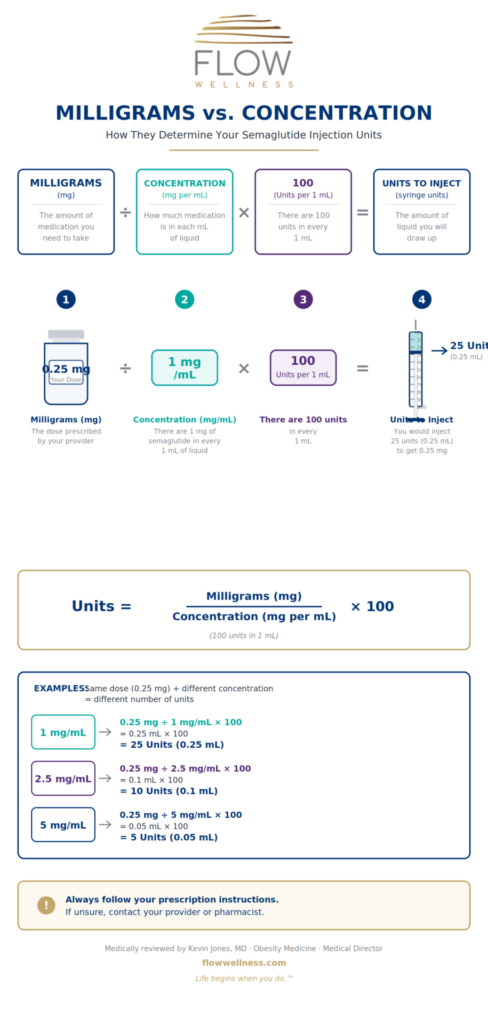
0.25 mg of semaglutide equals 25 units on a U-100 insulin syringe when your vial is 1 mg/mL — the most common compounded strength. At 2.5 mg/mL, the same 0.25 mg dose is only 10 units.
Going the other way: 40 units equals 0.4 mg at 1 mg/mL, or 1.0 mg at 2.5 mg/mL.
The number of units depends entirely on your vial’s concentration, and the same unit mark can mean a five-fold difference in dose. Always confirm the mg/mL printed on your pharmacy label before drawing up.
Your vial is labeled in milligrams. Your syringe is marked in units. Your provider gave you a dose in milligrams. Somewhere in between, the math has to happen — and getting it wrong isn’t a rounding error, it’s a dosing error. Here are both conversions, for every standard dose and every common concentration.
Injection Dose Calculator
Convert between milligram dosing (mg) and units. Units are the numbers used to measure medication on an insulin syringe. Insulin syringes are used for GLP-1 or peptide medication subcutaneous (SQ) injections. This calculator does not take the place of medical advice.
The calculator assumes U-100 insulin syringes. Please double check your syringes.
Milligrams (mg) to Units
Units to mg
The Only Formula You Need
Milligrams → Units: Units = (Dose in mg ÷ Concentration in mg/mL) × 100
Units → Milligrams: mg = (Units ÷ 100) × Concentration in mg/mL
Both assume a U-100 insulin syringe, where 100 units = 1 mL. That’s the syringe most pharmacies send with compounded semaglutide. If yours is marked in tenths of a milliliter instead, skip to the 1 mL syringe section below.
Semaglutide mg → Units Conversion Chart
Find your concentration across the top, your prescribed dose down the left.
| Dose | 1 mg/mL | 2 mg/mL | 2.5 mg/mL | 5 mg/mL |
|---|---|---|---|---|
| 0.25 mg | 25 units | 12.5 units | 10 units | 5 units |
| 0.5 mg | 50 units | 25 units | 20 units | 10 units |
| 1.0 mg | 100 units | 50 units | 40 units | 20 units |
| 1.7 mg | —* | 85 units | 68 units | 34 units |
| 2.4 mg | —* | —* | 96 units | 48 units |
*This dose exceeds 1 mL (100 units) at that concentration and can’t be drawn into a single standard insulin syringe. Pharmacies dispense a higher concentration for these doses — if your label doesn’t match, call your provider before injecting.
Semaglutide Units → mg Conversion Chart
This is the one most charts leave out. If your provider or pharmacy told you to draw “40 units,” here’s what that actually is.
| Units drawn | 1 mg/mL | 2 mg/mL | 2.5 mg/mL | 5 mg/mL |
|---|---|---|---|---|
| 5 units | 0.05 mg | 0.1 mg | 0.125 mg | 0.25 mg |
| 10 units | 0.1 mg | 0.2 mg | 0.25 mg | 0.5 mg |
| 20 units | 0.2 mg | 0.4 mg | 0.5 mg | 1.0 mg |
| 25 units | 0.25 mg | 0.5 mg | 0.625 mg | 1.25 mg |
| 40 units | 0.4 mg | 0.8 mg | 1.0 mg | 2.0 mg |
| 50 units | 0.5 mg | 1.0 mg | 1.25 mg | 2.5 mg |
| 75 units | 0.75 mg | 1.5 mg | 1.875 mg | 3.75 mg |
| 100 units | 1.0 mg | 2.0 mg | 2.5 mg | 5.0 mg |
Read that table twice. 40 units is 0.4 mg from one vial and 2.0 mg from another — a five-fold difference from the same mark on the same syringe. This is exactly why you cannot use someone else’s unit count, and why “how many units do you take?” is a meaningless question in a Facebook group.
How Many mg Is 40 Units of Semaglutide?
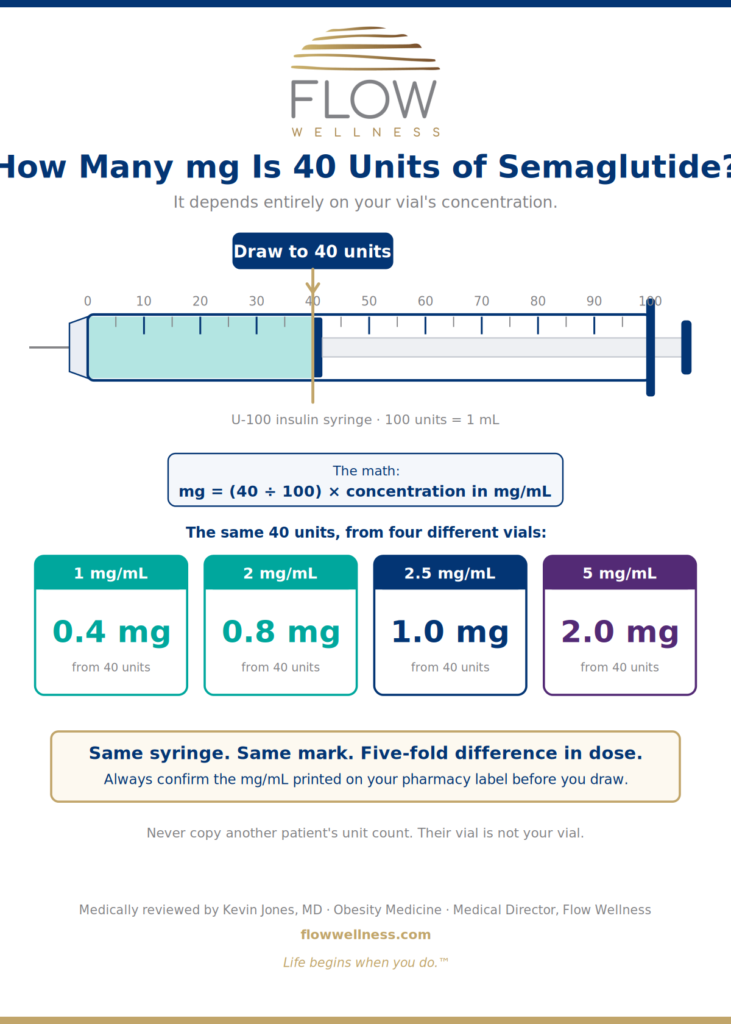
40 units of semaglutide is 1.0 mg if your concentration is 2.5 mg/mL, which is a common compounded strength and a standard maintenance dose. But:
- At 1 mg/mL → 40 units = 0.4 mg
- At 2 mg/mL → 40 units = 0.8 mg
- At 2.5 mg/mL → 40 units = 1.0 mg
- At 5 mg/mL → 40 units = 2.0 mg
Calculation: mg = (40 ÷ 100) × concentration. At 2.5 mg/mL: (0.4) × 2.5 = 1.0 mg.
If someone told you “40 units” without telling you the concentration, they didn’t tell you the dose.
How Many mg Is 10 Units of Semaglutide?
10 units is 0.25 mg at 2.5 mg/mL — a typical starting dose. At 1 mg/mL, 10 units is only 0.1 mg. At 5 mg/mL, it’s 0.5 mg.
Calculation: (10 ÷ 100) × concentration.
How Many Units Is 1 mg of Semaglutide?
1 mg of semaglutide is 40 units at 2.5 mg/mL, 50 units at 2 mg/mL, or a full 100-unit syringe at 1 mg/mL.
Calculation: (1 ÷ 2.5) × 100 = 40 units.
What If My Syringe Is Marked in mL, Not Units?
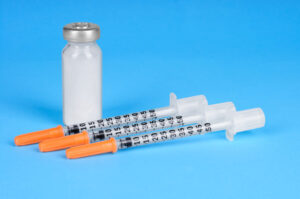
Not every pharmacy sends insulin syringes. Some send a 1 mL syringe marked in tenths and hundredths of a milliliter (0.1, 0.2, 0.3…) rather than in units. Same volume, different labels.
The conversion is simple: 100 units = 1 mL, so divide units by 100 to get mL.
| Units | Milliliters (mL) |
|---|---|
| 5 units | 0.05 mL |
| 10 units | 0.1 mL |
| 25 units | 0.25 mL |
| 40 units | 0.4 mL |
| 50 units | 0.5 mL |
| 100 units | 1.0 mL |
So 0.25 mg of semaglutide at 1 mg/mL is 0.25 mL on a 1 mL syringe — the quarter mark. To find your own: mL = Dose in mg ÷ Concentration in mg/mL.
If your syringe is larger than 1 mL (a 3 mL syringe, for instance), the markings are coarser and small doses are harder to measure accurately. Ask your provider whether an insulin syringe would be more appropriate.
Ozempic® and Wegovy® Pens Are Different
Everything above applies to compounded semaglutide in a vial. If you’re using a brand-name Ozempic or Wegovy pen, you don’t do this math at all — you dial the dose on the pen, and the pen delivers it. There are no units to count and no concentration to look up.
The confusion usually starts when someone switches from a pen to a vial, or reads advice online from someone using the other format. If you’re on a pen, ignore the unit conversions entirely and follow your pen’s dosing instructions.
The Most Common Dosing Mistakes We See
- Switching pharmacies and reusing the old unit count. Concentrations differ between pharmacies. Same dose, different units.
- Copying someone else’s units from a forum or group chat. Their vial isn’t your vial.
- Assuming all semaglutide is 1 mg/mL. It frequently isn’t.
- Confusing units with milligrams. They measure different things — units measure volume drawn, milligrams measure drug.
- Using a syringe different from the one your provider assumed.
If you are ever unsure, don’t guess. Take a photo of your vial label and syringe and send it to your provider before you inject. We would far rather double-check your dose than have you second-guess it at the kitchen table.
Standard Semaglutide Dose Schedule
Most patients follow a gradual escalation to reduce side effects. A typical schedule looks like:
| Weeks | Weekly Dose |
|---|---|
| 1–4 | 0.25 mg |
| 5–8 | 0.5 mg |
| 9–12 | 1.0 mg |
| 13–16 | 1.7 mg |
| 17+ | 2.4 mg (maintenance) |
Your provider may move faster or slower than this, and microdosing patients often start lower. Dose escalation should be a clinical decision, not a self-directed one.
Semaglutide Dosing Support in Oregon, Washington, and California
At Flow Wellness, every patient on semaglutide gets walked through their exact concentration, their exact unit count, and what their syringe should look like when it’s drawn correctly. Our medical weight loss program includes provider guidance built around your health history, body composition scans to track muscle and visceral fat rather than just weight, nutrition and lifestyle coaching, and ongoing support between visits.
We see patients in Bend, Oregon and Seattle, Washington, and by telehealth across California, Oregon, and Washington. Book a free consultation, or call the clinic at 541-422-3569.
Taking tirzepatide instead? See our tirzepatide units conversion chart.
Last Updated July 2026
Author: Allison Jones, F-NP
Medically reviewed by Dr. Kevin Jones, MD
Board Certified in Obesity Medicine
Medical Director, Flow Wellness
Frequently Asked Questions
How many units is 0.25 mg of semaglutide?
0.25 mg of semaglutide is 25 units on a U-100 insulin syringe if your concentration is 1 mg/mL, or 10 units if your concentration is 2.5 mg/mL. Formula: Units = (Dose in mg ÷ Concentration in mg/mL) × 100. Always check the concentration on your vial label.
How many mg is 40 units of semaglutide?
40 units of semaglutide is 1.0 mg at a concentration of 2.5 mg/mL, 0.8 mg at 2 mg/mL, 0.4 mg at 1 mg/mL, or 2.0 mg at 5 mg/mL. Formula: mg = (Units ÷ 100) × Concentration. The same 40-unit mark can be a five-fold difference in dose depending on your vial.
How many mg is 10 units of semaglutide?
10 units of semaglutide is 0.25 mg at a concentration of 2.5 mg/mL, 0.1 mg at 1 mg/mL, or 0.5 mg at 5 mg/mL. Formula: mg = (10 ÷ 100) × Concentration.
How many units is 1 mg of semaglutide?
1 mg of semaglutide is 40 units at 2.5 mg/mL, 50 units at 2 mg/mL, or 100 units (a full 1 mL syringe) at 1 mg/mL. Formula: (1 ÷ Concentration) × 100.
How many units is 0.5 mg of semaglutide?
0.5 mg of semaglutide is 50 units at 1 mg/mL, 25 units at 2 mg/mL, 20 units at 2.5 mg/mL, or 10 units at 5 mg/mL.
How many units are in 1 mL of semaglutide?
There are 100 units in 1 mL on a U-100 insulin syringe. This is a fixed relationship between units and volume and does not change with concentration — but how many milligrams those 100 units contain depends entirely on the concentration of your vial.
How do I convert semaglutide units to mg?
To convert units to milligrams, you need your vial’s concentration in mg/mL. Formula: mg = (Units ÷ 100) × Concentration in mg/mL. For example, 40 units from a 2.5 mg/mL vial: (40 ÷ 100) × 2.5 = 1.0 mg.
What is 0.25 mg on a 1 mL syringe?
If your concentration is 1 mg/mL, 0.25 mg is 0.25 mL — the quarter mark on a 1 mL syringe. To calculate for any vial: mL = Dose in mg ÷ Concentration in mg/mL.
Why is my semaglutide dose a different number of units than someone else’s?
Because compounded semaglutide is dispensed at different concentrations. Two people can take the identical milligram dose and draw very different unit amounts. This is why you should never copy dosing instructions from another patient or an online group.
Does this apply to Ozempic or Wegovy pens?
No. Ozempic and Wegovy pens are dialed to a dose and deliver it automatically — there are no units to convert. These conversions apply to compounded semaglutide drawn from a vial with a syringe.
What if I accidentally injected the wrong dose?
Contact your prescribing provider. Too much semaglutide can cause nausea, vomiting, diarrhea, abdominal pain, or dehydration; too little may simply be less effective. Severe complications are uncommon, but your provider should know so they can advise you on your next dose. If symptoms are severe or you have signs of a medical emergency, seek immediate care.
References
- U.S. Food and Drug Administration. Wegovy® (semaglutide) Prescribing Information.
- U.S. Food and Drug Administration. Ozempic® (semaglutide) Prescribing Information.
- U.S. Food and Drug Administration. Compounding and the FDA: Questions and Answers.
Related GLP-1 Resources

GLP-1 Weight Loss & Microdosing
Personalized GLP-1 Programs For Lasting Results GLP 1 Weight Loss & Microdosing Clinics In Bend & Seattle and serving CA, OR, and WA via telehealth

Tips for Starting GLP-1 Medications
What to Expect When Starting GLP-1 Medication Starting a GLP-1 medication like semaglutide or tirzepatide can feel exciting—and a little overwhelming. You may wonder what
How Many Units Is 2.5 mg of Tirzepatide? Conversion Chart for All Doses
Quick answer: 2.5 mg of tirzepatide equals 25 units on a standard U-100 insulin syringe when your vial concentration is 10 mg/mL — the most