
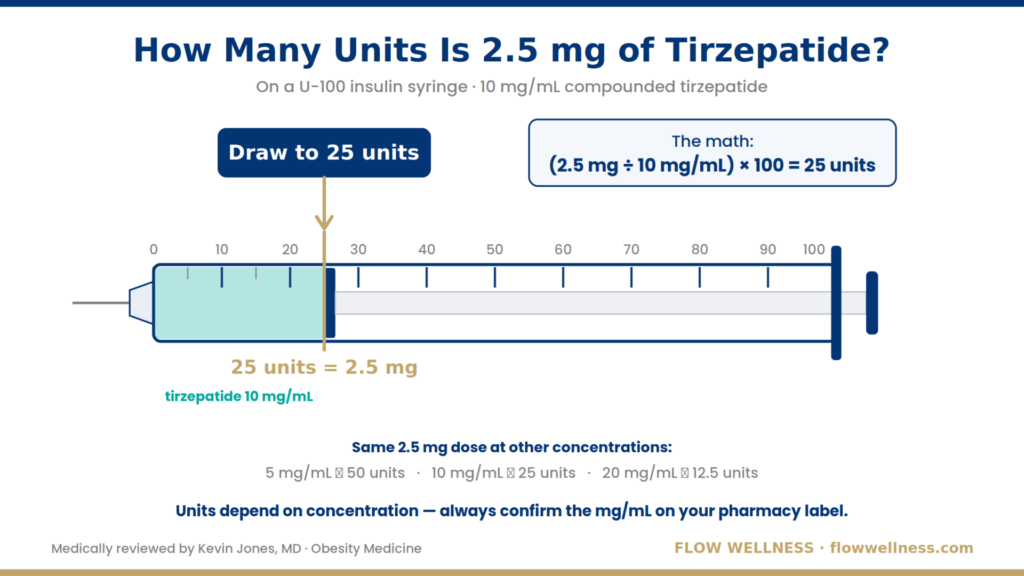
Quick answer: 2.5 mg of tirzepatide equals 25 units on a standard U-100 insulin syringe when your vial concentration is 10 mg/mL — the most common compounded strength. If your vial is 5 mg/mL, 2.5 mg = 50 units. Units depend entirely on your vial's concentration, so always confirm the mg/mL printed on your pharmacy label before drawing up your dose.
Written by Allison Jones, FNP · Medically reviewed by Dr. Kevin Jones, MD, Board-Certified Obesity Medicine Physician, Medical Director, Flow Wellness Last updated: July 2026
Let’s be honest—GLP-1 shots like tirzepatide can do great things for your health, but figuring out your dose can be confusing.
Your vial says milligrams (mg), your syringe says units (U) or milliliters (ml), and suddenly it feels like a math test.
Don’t worry. Flow Wellness will help you make sense of it.
The Basics
Tirzepatide dosing (and similar GLP-1s like semaglutide) is measured in milligrams (mg).
Insulin syringes measure volume in units (U) or milliliters (ml).
There are 100 units in 1 milliliter (mL) in a standard U-100 insulin syringe.
To find out how many units you need, you have to know how strong your medicine is—how many milligrams are in each milliliter. This is called the concentration, and it’s always printed on your vial.
Example: How Many Units Is 2.5 mg?
Say your vial says Tirzepatide 10 mg / 1 mL.
That means:
1 mL (100 units) = 10 mg
If your dose is 2.5 mg, here’s the math:
2.5 ÷ 10 = 0.25 mL
0.25 mL × 100 = 25 units
Answer: 2.5 mg = 25 units (when your vial is 10 mg/mL)
Table of Contents
Tirzepatide mg-to-Units Master Conversion Chart (All Doses)
The chart below covers every standard tirzepatide dose (2.5 mg through 15 mg) across the four most common compounded concentrations. Find your concentration in the top row, your prescribed dose in the left column, and read across.
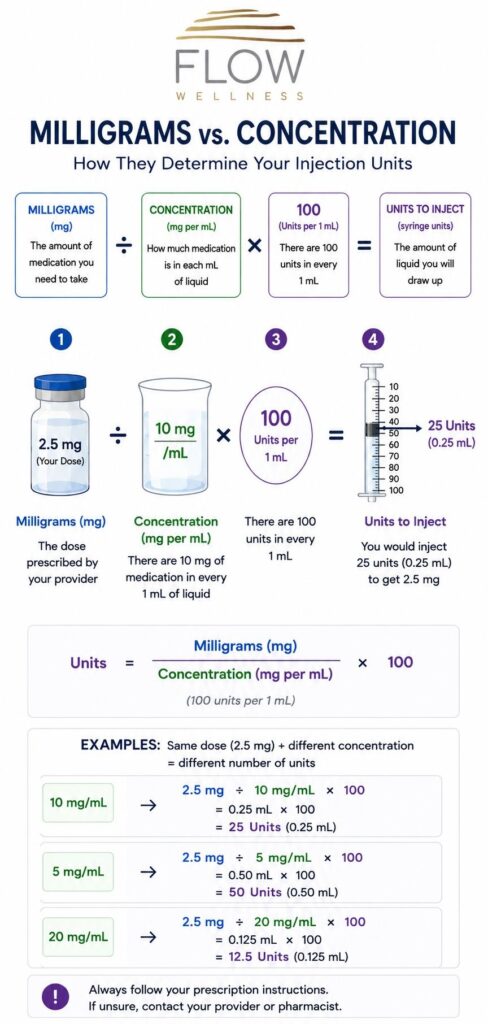
Units on a U-100 insulin syringe = (Dose in mg ÷ Concentration in mg/mL) × 100
| Dose | 5 mg/mL | 10 mg/mL | 15 mg/mL | 20 mg/mL |
|---|---|---|---|---|
| 2.5 mg | 50 units | 25 units | ~17 units* | 12.5 units |
| 5 mg | 100 units | 50 units | ~33 units* | 25 units |
| 7.5 mg | —† | 75 units | 50 units | 37.5 units |
| 10 mg | —† | 100 units | ~67 units* | 50 units |
| 12.5 mg | —† | —† | ~83 units* | 62.5 units |
| 15 mg | —† | —† | 100 units | 75 units |
*These conversions don’t land on a clean syringe marking. Confirm the exact draw with your provider before injecting. †This dose exceeds 1 mL (100 units) at this concentration and can’t be drawn in a single standard insulin syringe. Your pharmacy will typically dispense a higher concentration for these doses—contact your provider if your label doesn’t match.
Always check your pharmacy label before drawing up your dose—tirzepatide can come in different strengths.
Why Tirzepatide Units Can Be Confusing
Many patients assume that milligrams (mg) and units are interchangeable, but they measure different things.
- Milligrams (mg) measure the amount of medication.
- Milliliters (mL) measure the volume of liquid.
- Units measure the amount drawn into an insulin syringe.
Because different pharmacies may use different concentrations, the same 2.5 mg dose may require a different number of units depending on the vial strength.
For example:
- 2.5 mg from a 5 mg/mL vial = 50 units
- 2.5 mg from a 10 mg/mL vial = 25 units
- 2.5 mg from a 20 mg/mL vial = 12.5 units
This is why patients should never copy someone else’s dosing instructions.
How To Calculate Tirzepatide Units
To determine the correct number of units:
Units = (Desired Dose ÷ Concentration) × 100
Example:
Desired dose = 2.5 mg
Concentration = 10 mg/mL
Units = (2.5 ÷ 10) × 100
Units = 25
This formula works for tirzepatide, semaglutide, and many other medications administered with U-100 insulin syringes.
Injection Dose Calculator
Convert between milligram dosing (mg) and units. Units are the numbers used to measure medication on an insulin syringe. Insulin syringes are used for GLP-1 or peptide medication subcutaneous (SQ) injections. This calculator does not take the place of medical advice. The calculator assumes U-100 insulin syringes. Please double check your syringes.
Milligrams (mg) to Units
Units to mg
Common Tirzepatide Concentrations
The most common compounded tirzepatide concentrations include:
| Concentration | Common Use |
| 5 mg/mL | Lower concentration (uncommon) |
| 10 mg/mL | Common concentration |
| 15 mg/mL | Higher concentration (typically used for doses over 10 mg) |
| 20 mg/mL | Concentrated formulations (typically used for doses over 10 mg) |
Tirzepatide Dosing Conversion Chart
5 mg/mL Concentration
| Dose | Units |
| 2.5 mg | 50 units |
| 5 mg | 100 units |
10 mg/mL Concentration
| Dose | Units |
| 2.5 mg | 25 units |
| 5 mg | 50 units |
| 7.5 mg | 75 units |
20 mg/mL Concentration
| Dose | Units |
| 2.5 mg | 12.5 units |
| 5 mg | 25 units |
| 10 mg | 50 units |
| 15 mg | 75 units |
Zepbound Vial Dosing
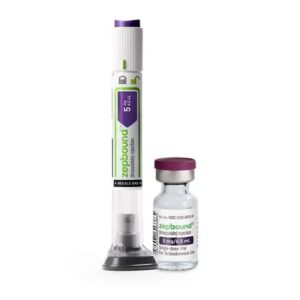
If you’re using brand-name single-dose Zepbound® vials, the math is done for you: each vial strength is formulated so the full dose equals 0.5 mL (50 units), regardless of your milligram dose. In other words, whether your prescription is 2.5 mg or 15 mg, you draw the entire vial—50 units on a U-100 syringe. This applies only to brand-name single-dose vials; compounded tirzepatide follows the concentration math above. For full details, see the FDA-approved Zepbound prescribing information.
Common Tirzepatide Dosing Mistakes
Most dosing errors occur when patients:
- Switch pharmacies without noticing a concentration change.
- Assume all tirzepatide vials have the same strength.
- Use an old dosing chart from a previous prescription.
- Confuse milligrams and units.
- Use a syringe different from the one recommended by their provider.
If you are ever uncertain, contact your provider before taking your injection.
Don’t Guess Your Dose
Using the wrong amount can make you feel awful—or stall your progress.
That’s why Flow Wellness walks every patient through their exact dose, syringe markings, and step-by-step plan.
No confusion. No internet math. Just clear instructions from real medical professionals.
Exceptions
Not every pharmacy includes insulin syringes with your medication (because, of course, that would be too easy). Some vials come with syringes marked in tenths of a milliliter (mL), and others may include larger 3 mL syringes.
That’s why it’s so important to understand your exact dose—and remember that the amount you draw up depends on both your prescribed dose and the strength of your medication.

Tirzepatide Weight Loss Support in California, Oregon, and Washington
At Flow Wellness, we help patients understand every aspect of their GLP-1 treatment program, including medication dosing, side effect management, nutrition, and long-term success strategies.
Our medical weight loss program includes:
- Personalized provider guidance
- Tirzepatide and semaglutide treatment options
- Oral GLP-1 medication options
- Nutrition and lifestyle coaching
- Body composition scans to track muscle and visceral fat
- Ongoing provider support
- Free initial consultation!
Whether you are located in Bend, Oregon, Seattle, Washington, or receiving care in California, Oregon, or Washington through telehealth, our team is available to help answer questions about your medication and treatment plan.
Learn more about our medical weight loss program here.
You can also contact our team directly.
If anything feels unclear, don’t guess. We’re here to help. Stop by the office, give us a call, or send a quick photo to your provider for confirmation. We’d much rather double-check your syringe than have you second-guess your dose.
Watch this video to have the Flow Wellness owner and medical director walk you through drawing up your medicine and giving yourself an injection.
Have more questions, please don’t hesitate to call the clinic at 541-422-3569 or message us at info@theflowwellness.com. We’re always here for you!
Medically Reviewed By
Dr. Kevin Jones, MD
Board-Certified Obesity Medicine Physician
Medical Director, Flow Wellness
Last update: July 2026
Tirzepatide mg and unit FAQs
How many units is 2.5 mg of tirzepatide?
2.5 mg of tirzepatide equals 25 units on a U-100 insulin syringe if your concentration is 10 mg/mL, or 50 units if your concentration is 5 mg/mL. The number of units depends on the concentration printed on your vial.
To calculate the dose, use the formula: Units = (Dose in mg ÷ Concentration in mg/mL) × 100. For example: (2.5 ÷ 10) × 100 = 25 units.
At Flow Wellness, our medical weight loss providers help patients understand their medication concentration and dosing instructions to ensure safe and accurate GLP-1 treatment. See the Flow Wellness dose calculator to check your dose.
Is 2.5 mg the starting dose of tirzepatide?
Yes. For most patients, 2.5 mg once weekly is the recommended starting dose of tirzepatide. This introductory dose allows your body to adjust to the medication before increasing to higher maintenance doses that may produce greater weight loss and metabolic benefits. Microdosing patients will typically start at a lower dose.
At Flow Wellness, patients receive ongoing provider support, body composition monitoring, and treatment plans built around their goals to help maximize results while minimizing side effects during dose escalation.
How many units is 5 mg of tirzepatide?
5 mg of tirzepatide equals 50 units at a concentration of 10 mg/mL, or 25 units at a concentration of 20 mg/mL.
Example calculation: (5 ÷ 10) × 100 = 50 units.
Because different pharmacies may dispense tirzepatide at different strengths, Flow Wellness recommends always checking the concentration listed on your prescription label before administering your injection. See the Flow Wellness dose calculator to check your dose.
How many units is 7.5 mg of tirzepatide?
7.5 mg of tirzepatide equals 75 units at a concentration of 10 mg/mL, or 50 units at a concentration of 15 mg/mL.
Example calculation: (7.5 ÷ 15) × 100 = 50 units.
At Flow Wellness, our providers review medication instructions with patients and are available to answer dosing questions throughout treatment. See the Flow Wellness dose calculator to check your dose.
How many units is 10 mg of tirzepatide?
10 mg of tirzepatide equals 50 units at a concentration of 20 mg/mL, or 100 units (a full 1 mL syringe) at a concentration of 10 mg/mL.
Example calculation: (10 ÷ 20) × 100 = 50 units.
Because tirzepatide can be dispensed in multiple concentrations, Flow Wellness encourages patients to verify the concentration listed on their prescription label before calculating their dose. See the Flow Wellness dose calculator to check your dose.
How many units is 12.5 mg of tirzepatide?
12.5 mg of tirzepatide equals 62.5 units at a concentration of 20 mg/mL, or 50 units at a concentration of 25 mg/mL.
Example calculation: (12.5 ÷ 25) × 100 = 50 units.
At Flow Wellness, our medical weight loss team helps patients understand dosing calculations and provides ongoing support throughout their GLP-1 treatment journey. See the Flow Wellness dose calculator to check your dose.
How many units is 15 mg of tirzepatide?
15 mg of tirzepatide equals 75 units at a concentration of 20 mg/mL, or 50 units at a concentration of 30 mg/mL.
Example calculation: (15 ÷ 30) × 100 = 50 units.
Because multiple concentrations exist, Flow Wellness recommends confirming your medication strength before each dose and contacting your provider if you have any questions. See the Flow Wellness dose calculator to check your dose.
How do I convert tirzepatide mg to units?
To convert tirzepatide milligrams (mg) to units, you must know the concentration of your medication in mg/mL.
Formula: Units = (Dose in mg ÷ Concentration in mg/mL) × 100
For example, if your prescribed dose is 5 mg and your medication concentration is 10 mg/mL: (5 ÷ 10) × 100 = 50 units.
The same dose in milligrams can require a different number of units if the medication concentration changes. At Flow Wellness, our providers help patients understand these calculations and ensure safe, accurate dosing throughout their medical weight loss program. See the Flow Wellness dose calculator to do this calculation.
Can I use the same dosing chart for semaglutide?
Not necessarily. Semaglutide and tirzepatide are often dispensed at different concentrations, meaning the number of units required for the same milligram dose may differ. Always use the dosing instructions provided specifically for your prescription.
At Flow Wellness, we provide dosing guidance for both semaglutide and tirzepatide and help patients understand the differences between these medications as part of our comprehensive GLP-1 weight loss program.
What happens if I accidentally take too much tirzepatide?
Patients who accidentally take too much tirzepatide may experience nausea, vomiting, diarrhea, abdominal discomfort, dehydration, or other gastrointestinal side effects. While severe complications are uncommon, patients should contact their prescribing provider if they believe they have taken an incorrect dose.
At Flow Wellness, our providers are available to help patients manage medication-related concerns and provide guidance if a dosing error occurs. If symptoms are severe or you experience signs of a medical emergency, seek immediate medical attention.
What concentration of tirzepatide do I have?
Why is my tirzepatide dose different from someone else's?
Can I switch pharmacies and use the same number of units?
How do I know my tirzepatide concentration?
Can Flow Wellness help me calculate my tirzepatide dose?
Related GLP-1 Resources

The Best Part About GLP-1 Therapy Might Not Be the Weight You Lose
Do GLP-1 Medications Improve Quality of Life? What the Research Shows For years, conversations about GLP-1 medications focused almost entirely on the number on the

Your At-Home Injection Guide (Spoiler: It’s Easier Than You Think)
How to Give Yourself an Injection (Step by Step) So you’ve decided that an injectable medication, supplement, or peptide is the right next step for
Unboxing Your Medication: What GLP-1 Vials Really Look Like
What GLP-1 Vials Look Like and How to Read the Prescription Label Starting GLP-1 therapy—or transitioning to a new formulation—is an exciting step, but let’s